
What Happens When You Withdraw Retirement Funds Early
Cashing out a traditional 401(k) or IRA before age 59½ sets off an immediate chain of financial consequences. The IRS treats the withdrawn amount as ordinary income, meaning it is added to your taxable income for that year and taxed at your marginal rate. On top of that, a 10% early withdrawal penalty applies in most cases.
For example, if you withdraw $20,000 and fall in the 22% federal income tax bracket, you could owe $4,400 in federal income taxes plus a $2,000 penalty - leaving you with roughly $13,600 to actually apply toward your debt. State income taxes, where applicable, reduce that figure further.
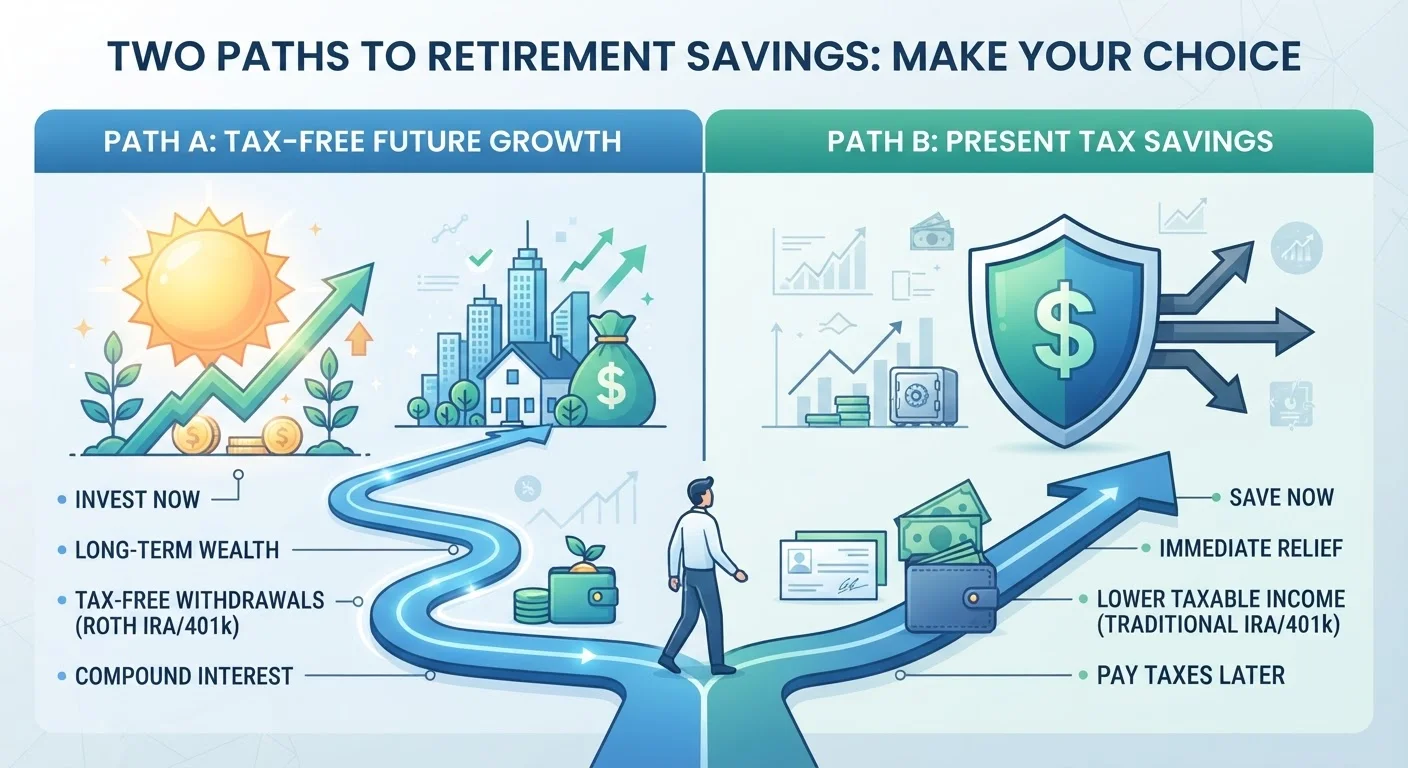
Roth IRAs operate somewhat differently. Contributions (but not earnings) can be withdrawn at any time without taxes or penalties, since those dollars were already taxed. For a full comparison of how each account type handles withdrawals, see how Roth and Traditional IRAs differ on withdrawals.
Hardship Withdrawals vs. 401(k) Loans
Some employer plans allow participants to take a loan against their 401(k) balance rather than a full withdrawal. A 401(k) loan avoids the immediate tax hit and penalty, provided it is repaid on schedule - typically within five years. However, if you leave your job while a loan is outstanding, the remaining balance may become due quickly or be treated as a taxable distribution. Hardship withdrawals are a separate provision and carry different rules; check your specific plan documents for details.
The Pros: Where This Strategy Has Merit
Despite the steep costs, there are legitimate reasons some people consider this option.
Eliminates high-interest debt immediately
Paying off credit card or personal loan balances removes a guaranteed interest drain - sometimes at rates exceeding 20% annually - which can improve monthly cash flow right away.
Reduces financial stress and simplifies obligations
Becoming debt-free can lower psychological burden and make budgeting more straightforward, particularly for households stretched thin by multiple minimum payments.
Certain hardship exceptions waive the penalty
The IRS permits penalty-free early withdrawals under specific qualifying hardships, such as total and permanent disability or substantially equal periodic payments (72(t) distributions), though ordinary income tax still applies.
High-interest debt - particularly credit card balances carrying rates above 20% - can be a genuine financial emergency. In such cases, the guaranteed "return" of eliminating that interest cost may, in narrow scenarios, rival what retirement investments might realistically earn. The psychological and cash-flow relief of becoming debt-free also has real value for households under sustained financial stress.
The Cons: What You're Really Giving Up
The drawbacks of tapping retirement savings are significant and, for most people, outweigh the benefits.
Early withdrawal triggers taxes and a 10% penalty
For those under 59½, the withdrawn amount is taxed as ordinary income and subject to a 10% federal penalty, meaning you may receive only 65-75 cents on every dollar withdrawn after taxes.
Compound growth is permanently forfeited
Dollars removed from a retirement account stop compounding immediately; money withdrawn in your 30s or 40s could have grown to multiples of its original value by retirement age.
Creates a gap that is difficult to refill
Annual IRA and 401(k) contribution limits restrict how quickly you can replenish withdrawn funds, making it harder to restore your retirement trajectory even after the debt is resolved.
May not solve the underlying spending problem
If the debt accumulated due to a spending imbalance, eliminating it with retirement funds does not address the root cause and may result in new debt forming within a few years.
Perhaps the most underappreciated cost is lost compound growth. A $20,000 withdrawal at age 35 does not simply cost $20,000 - it costs every dollar that amount would have compounded into over the next 30 years. Depending on assumed returns, that could represent well over $100,000 in foregone retirement wealth. As explored in our piece on common debt myths that cost people money, the emotional pull to eliminate debt at any cost can lead to decisions with steep hidden price tags.
Alternatives Worth Exploring First
Before reaching into a retirement account, consider whether other debt-relief strategies could achieve a similar outcome at lower cost.
- Debt consolidation: Combining multiple high-interest balances into a single lower-rate loan can meaningfully cut interest costs without touching retirement assets. Our full overview of debt consolidation walks through when it works and when it doesn't.
- Structured payoff strategies: The avalanche and snowball methods can accelerate debt elimination using your existing income. See how the debt avalanche and snowball approaches work to find the right fit.
- Doing both simultaneously: It's often possible to chip away at debt while still contributing to retirement savings. Saving while in debt outlines a practical framework for managing both goals at once.
10%
Federal early withdrawal penalty rate
The IRS imposes a 10% penalty on most retirement account withdrawals made before age 59½, in addition to ordinary income taxes owed.
~30%
Potential tax bite on early withdrawal
When federal income tax and the early withdrawal penalty are combined, a filer in the 22% bracket can lose roughly 30 cents of every dollar withdrawn before state taxes are considered.
This article is for general informational purposes only and does not constitute personalised financial, tax, or investment advice. Consult a qualified financial adviser or tax professional before making decisions that affect your retirement savings or debt strategy.