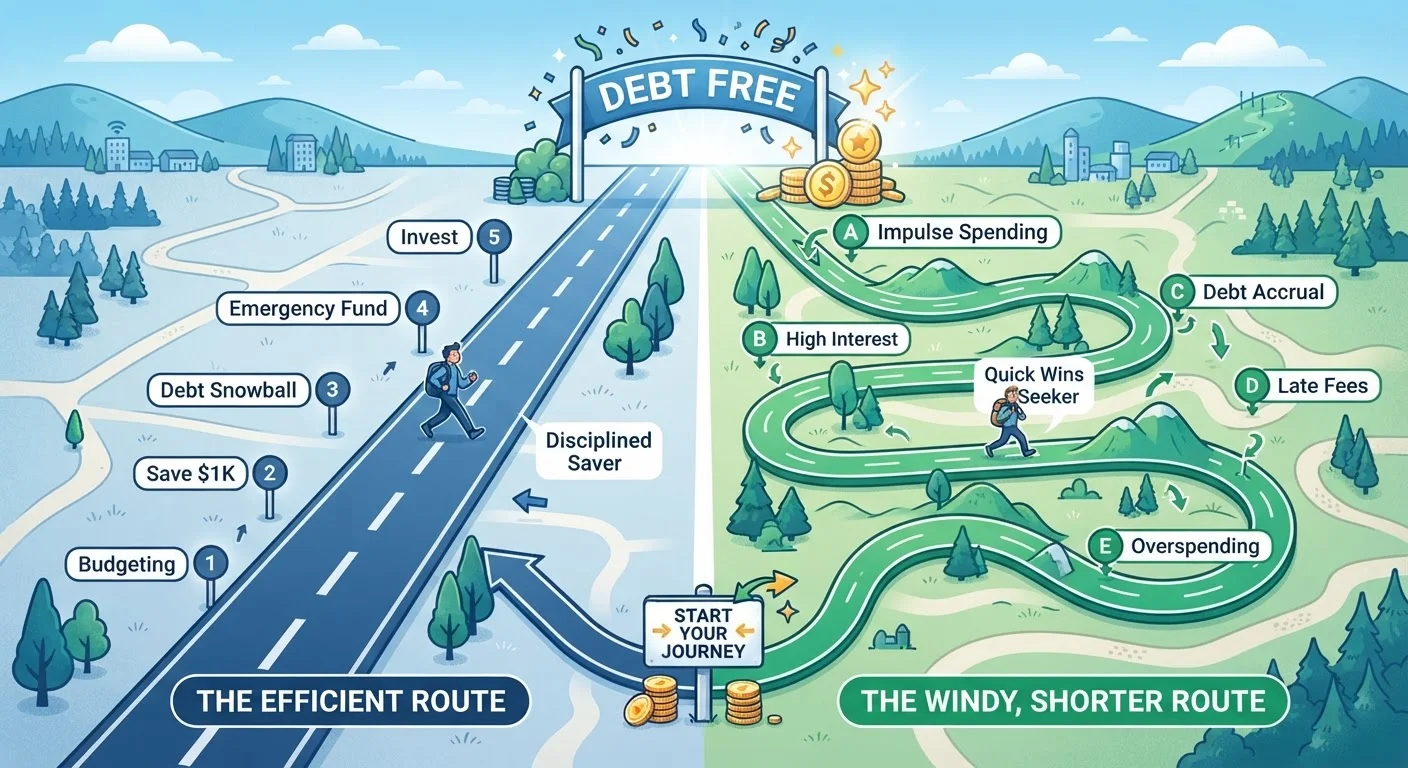

Why Debt Myths Are So Costly
Widely shared beliefs about debt repayment can feel like common sense - but several of the most popular ones lead people to make decisions that cost them real money. Whether it's avoiding savings while carrying a balance or closing accounts to look more responsible, acting on bad information quietly compounds the problem.
This article addresses six persistent myths about paying off debt, what the evidence actually shows, and why the distinction matters for your financial health. It is general educational information, not personalized financial advice. For guidance tailored to your situation, consult a licensed financial professional.
Myth
You should always pay off all debt before saving any money.
Fact
Carrying some debt while building savings is often the more financially sound approach, especially when an emergency fund is absent.
Without any cash reserves, an unexpected expense - a car repair, a medical bill, a job disruption - forces you to put new charges on high-interest credit, erasing months of payoff progress. Most financial educators suggest maintaining a small emergency fund (commonly cited as one to three months of essential expenses) even while actively reducing debt. The math isn't always clean, but the risk management case is strong.
Myth
Making the minimum payment each month keeps you in good shape.
Fact
Minimum payments are designed to keep accounts current, not to help you pay off debt efficiently - they maximize the interest the lender collects.
On a $5,000 credit card balance at 20% APR, paying only the minimum each month can extend repayment to well over a decade and roughly double the total amount paid. Minimum payments cover little beyond accruing interest in the early months. Even a modest increase above the minimum - consistently applied - can cut repayment time and total interest substantially.
[stat_highlights]Myth
All debt is bad and should be eliminated as fast as possible.
Fact
Debt has different risk profiles depending on the interest rate, tax treatment, and purpose. Low-cost debt is not the same financial threat as high-rate consumer debt.
A fixed-rate mortgage at a relatively low interest rate, for instance, behaves very differently from a 25% APR credit card balance. Aggressively prepaying a low-rate loan instead of directing that money toward higher-interest debt - or toward an employer-matched retirement account - can actually reduce net worth over time. The key variable is the cost of the debt, not its mere existence.
Myth
Closing a paid-off credit card improves your credit score.
Fact
Closing a credit card account typically lowers your credit score by reducing available credit and increasing your credit utilization ratio.
Credit utilization - the percentage of your available revolving credit that you're using - is one of the most influential factors in widely used credit scoring models. Closing an account removes that credit limit from your total available credit, which pushes your utilization ratio up even if your balances haven't changed. Unless a card carries an annual fee that isn't justified, keeping the account open and unused is usually the credit-healthier choice.
Myth
You should always pay off the largest balance first.
Fact
Targeting the highest interest rate first - not the largest balance - typically minimizes total interest paid across all debts.
This is the core principle of the debt avalanche method. A $2,000 balance at 24% APR costs more in monthly interest than a $6,000 balance at 8% APR. Directing extra payments toward the highest-rate debt first reduces the total cost of repayment, even if those balances aren't the biggest on paper. The debt snowball - paying smallest balances first - can be useful for psychological momentum, but it generally costs more in interest over time.
Myth
Cashing out retirement savings to pay off debt is a straightforward solution.
Fact
Early withdrawal from retirement accounts typically triggers income taxes and a 10% penalty, and permanently sacrifices decades of compounding growth.
The visible appeal - eliminating debt immediately - tends to obscure the compounding cost. A $10,000 early withdrawal from a traditional 401(k) might net only $6,500-$7,000 after taxes and the penalty, depending on the account holder's tax bracket. More significantly, that money no longer grows tax-deferred. Our article on the trade-offs of using retirement savings to pay off debt covers this in detail. This strategy may make sense in specific circumstances, but it warrants careful analysis - not a reflexive move.
Building a Smarter Debt Payoff Strategy
Once you've cleared up the misconceptions, a more effective path becomes visible. Two evidence-based frameworks - the debt avalanche (paying highest-interest balances first) and the debt snowball (clearing smallest balances first for momentum) - offer structured starting points. Our in-depth guide to the debt avalanche and debt snowball walks through how each works and which fits different financial situations.
Your debt-to-income ratio is another useful lens - lenders use it, but it also tells you something meaningful about the relationship between what you owe and what you earn. Tracking it over time can reveal real progress even when balances feel stubborn.
If you're juggling multiple accounts at high rates, debt consolidation may simplify repayment - but it's not a fit for every situation. Understanding the trade-offs matters before committing.
Debt Consolidation Isn't Risk-Free
Consolidating multiple debts into a single loan can reduce interest costs and simplify repayment - but it comes with caveats. Secured consolidation loans put assets at risk if you can't repay, and extending your repayment term can mean paying more total interest even at a lower rate. Always read the full loan terms and compare the total cost of repayment, not just the monthly payment.
Finally, a solid budget is the foundation under any payoff plan. The Budgeting Basics hub offers practical strategies for tracking spending and freeing up cash to put toward balances each month.
This article is for general informational purposes only and does not constitute personalized financial, tax, or legal advice. Consult a qualified financial professional before making decisions about your debt repayment strategy.