
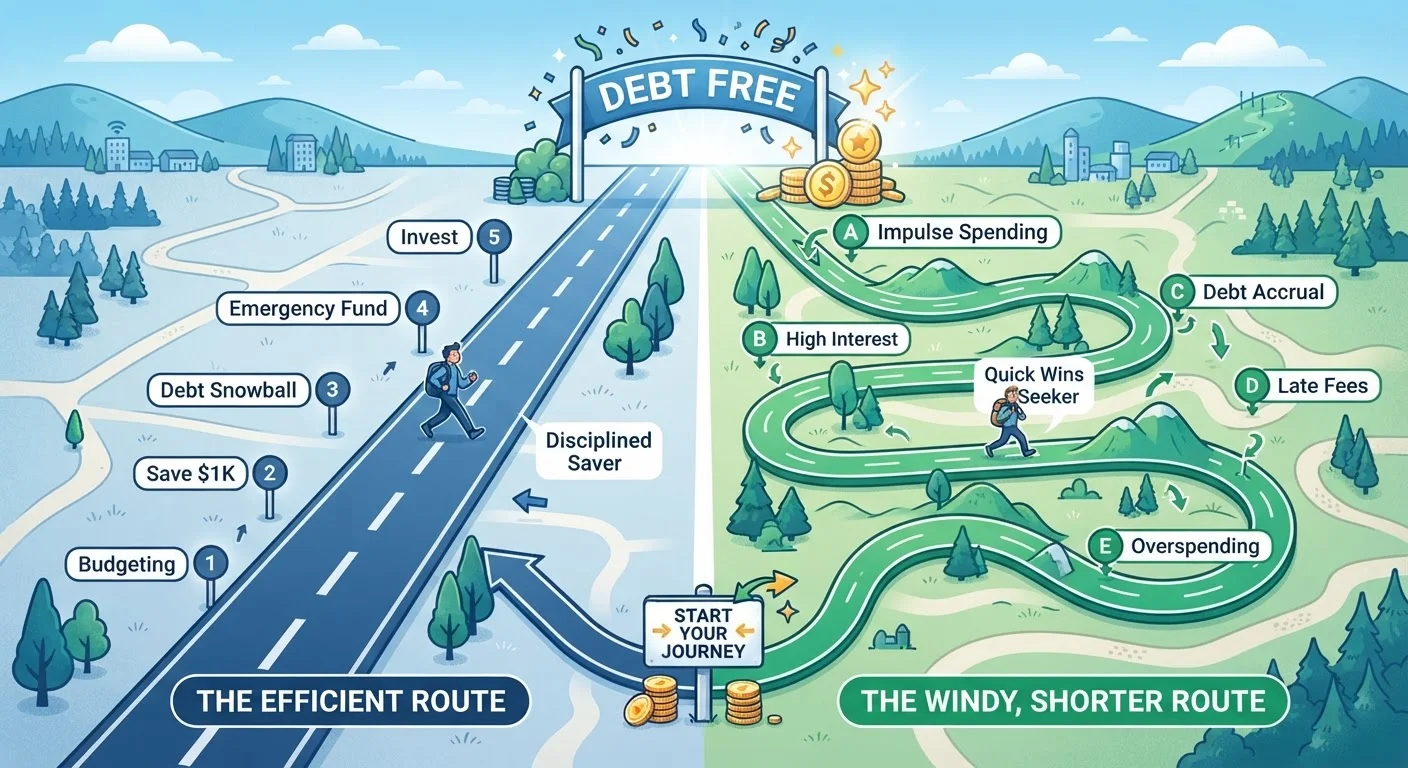
How Both Strategies Actually Work
Both the Debt Avalanche and the Debt Snowball share the same mechanical foundation: continue making minimum payments on every account you owe, then direct any extra money - even a modest amount - toward one designated target debt. The difference lies entirely in how you choose that target.
With the Debt Avalanche, you rank your debts by APR and attack the highest-rate balance first. Once that balance reaches zero, you roll what you were paying into the next-highest-rate debt, and so on. Because you're neutralising the most expensive debt earliest, you're limiting how long compound interest can work against you - which typically results in paying less money overall. For a plain-language explanation of APR and compound interest, see our financial terms reference guide.
With the Debt Snowball, you rank your debts by balance size - smallest to largest - regardless of interest rate. You put extra funds toward the smallest balance first. When it's gone, the payment you were making on it gets added to the next-smallest balance, and the cycle continues. The name reflects this rolling, compounding momentum.
| Criterion | Debt Avalanche | Debt Snowball |
|---|---|---|
| Payoff order | Highest interest rate first | Smallest balance first |
| Total interest paid | Generally lower | Generally higher |
| Time to first payoff | Potentially longer | Typically faster |
| Motivation model | Long-term, math-driven | Short-term wins, momentum |
| Best rate environment | Large spread between APRs | Similar APRs across debts |
| Primary risk | Slow early progress may discourage | Costly if high-rate debt lingers |
The Real-World Trade-Offs
The avalanche's mathematical advantage is real but can be overstated in practice. If your highest-interest debt also carries a large balance, it may take months or even years to pay it off. During that time, nothing disappears from your statement - and for some people, that stalls progress entirely.
Behavioural finance research has consistently found that visible progress matters to long-term follow-through. The snowball method is designed around this reality: eliminating even a small account produces a genuine sense of accomplishment, which can reinforce the habit of paying extra each month. The tradeoff is that you may carry higher-interest debt longer than necessary.
~$1,000+
Potential interest savings with avalanche method
Consumer finance analyses consistently show the avalanche method saves hundreds to thousands of dollars depending on balance size, APR spread, and repayment timeline.
Higher
Snowball completion rates vs. avalanche in some studies
Academic research published in the Journal of Marketing Research found that focusing on eliminating individual accounts - regardless of rate - can improve debt repayment follow-through.
It's worth noting that the dollar difference between the two methods depends heavily on your specific debts. If your interest rates are clustered closely together, the gap is small. If one debt carries a dramatically higher rate, the avalanche pulls further ahead in savings. Running your own numbers - or asking a financial adviser to help - gives the clearest picture for your situation.
Some people also consider debt consolidation as an alternative to either method. Consolidation can simplify repayment by combining multiple balances into a single loan - though it has its own trade-offs and is not suited to every situation.
Choosing the Approach That Works for You
There is no universally correct answer. A strategy that eliminates debt on paper but that you abandon after three months will cost more than a less-optimal strategy you maintain consistently for three years.
A useful self-assessment: think about how you've handled financial goals in the past. If you tend to stay the course once you commit, the avalanche may suit you - you can tolerate a slow start knowing you're saving money long-term. If you thrive on checkpoints and milestones, the snowball's early payoffs may be the accountability structure you need.
You might also consider a hybrid approach - paying off one or two small balances first to clear your mental slate, then switching to avalanche order for the remaining, likely larger debts. This isn't textbook either strategy, but personal finance rarely is.
Whatever method you choose, pairing debt repayment with savings goals is achievable. Our guide to saving while paying down debt outlines a practical framework for doing both simultaneously. It's also worth reviewing common misconceptions before committing to a plan - some widely held myths about paying off debt can lead to costly decisions.
What About Debt Consolidation?
The avalanche and snowball are self-directed repayment strategies - they don't change your loan terms or interest rates. Debt consolidation is a separate tool that combines multiple debts into one, potentially at a lower rate. The two approaches aren't mutually exclusive: some borrowers consolidate first, then apply avalanche or snowball logic to the remaining balance. See our full overview of debt consolidation to understand when it makes sense.
This article is for general informational purposes only and does not constitute personalised financial or legal advice. Consult a licensed financial professional for guidance tailored to your individual circumstances.