
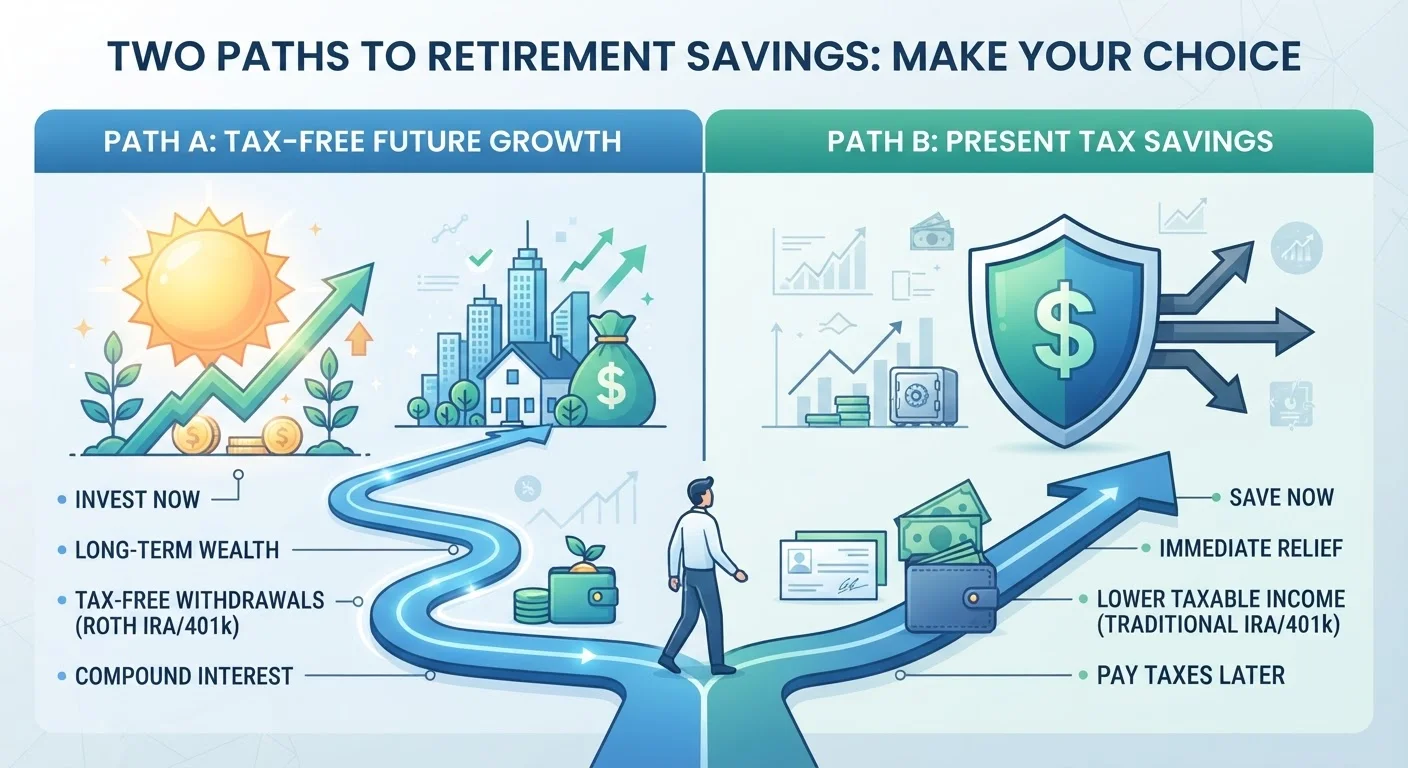
The Core Difference: When You Pay Taxes
Both a Roth IRA and a Traditional IRA are individual retirement accounts that let your money grow without being taxed each year - a significant advantage over a standard brokerage account. The fundamental difference is timing: when does the IRS take its share?
With a Roth IRA, you contribute money you've already paid income tax on. Your investments then grow tax-free, and qualified withdrawals in retirement - including all the gains - are also tax-free. With a Traditional IRA, you may contribute pre-tax dollars (subject to income rules), reducing your taxable income now. When you withdraw funds in retirement, those distributions are taxed as ordinary income.
Neither structure is universally superior. The right choice hinges primarily on whether you expect your tax rate to be higher today or during retirement. For a broader look at how these accounts fit into your overall financial picture, see Tax-Advantaged Accounts Every Beginning Investor Should Understand.
| Criterion | Roth IRA | Traditional IRA |
|---|---|---|
| Contribution tax treatment | After-tax dollars | Pre-tax (if deductible) |
| Tax on qualified withdrawals | Tax-free | Taxed as ordinary income |
| 2024 contribution limit | $7,000 ($8,000 age 50+) | $7,000 ($8,000 age 50+) |
| Income limits to contribute | Yes - phases out at higher income | No limit to contribute; deductibility phases out |
| Early withdrawal of contributions | Anytime, penalty-free | Subject to taxes and 10% penalty |
| Required minimum distributions | None during owner's lifetime | Required starting at age 73 |
| Best tax scenario | Higher tax rate in retirement | Lower tax rate in retirement |
Eligibility, Contribution Limits, and Income Rules
For 2024, both account types share the same contribution ceiling: $7,000 per year, or $8,000 if you are age 50 or older. You cannot contribute more than your taxable compensation for the year, and the limit applies across all IRAs you hold - not per account.
Roth IRA income limits: The ability to contribute directly to a Roth IRA phases out at higher income levels. In 2024, the phase-out begins at $146,000 for single filers and $230,000 for married couples filing jointly. Above the upper threshold, direct Roth contributions are not allowed (consult a financial professional about strategies that may be available).
Traditional IRA deductibility limits: Anyone with earned income can contribute to a Traditional IRA, but the tax deduction phases out if you (or a spouse) are covered by a workplace retirement plan and income exceeds certain thresholds. If neither you nor a spouse has access to a workplace plan, contributions are generally fully deductible regardless of income.
$7,000
2024 IRA annual contribution limit
Per IRS guidance, individuals under 50 may contribute up to $7,000 across all their IRA accounts combined in 2024.
Age 73
Traditional IRA RMD start age
Under the SECURE 2.0 Act, account holders must begin required minimum distributions from Traditional IRAs at age 73.
$146,000
Roth IRA phase-out starts (single filers)
For 2024, the Roth IRA contribution phase-out begins at $146,000 modified adjusted gross income for single tax filers, per IRS published limits.
Understanding where IRAs fit relative to saving vehicles is valuable context - the difference between saving and investing article explores how each serves a distinct role in building financial security.
Withdrawals, Penalties, and Required Distributions
Withdrawal rules are a critical - and often underappreciated - distinction between these two account types.
Roth IRA Withdrawals
- Contributions can be withdrawn at any time, at any age, without taxes or penalties (since you already paid tax on them).
- Earnings are tax-free and penalty-free if the account is at least five years old and you are age 59½ or older.
- No required minimum distributions (RMDs) apply during the account owner's lifetime, allowing the account to continue growing untouched if you don't need the funds.
Traditional IRA Withdrawals
- Withdrawals before age 59½ are generally subject to a 10% early withdrawal penalty plus ordinary income tax, with limited exceptions.
- Qualified withdrawals after 59½ are taxed as ordinary income.
- Required minimum distributions (RMDs) must begin at age 73 under current law, meaning you are required to withdraw - and pay tax on - a portion of the account each year whether you need the income or not.
If you've ever considered tapping retirement savings early to handle debt, understanding these penalty structures matters - the trade-offs of using retirement savings to pay off debt outlines the real costs involved.
This article is for general informational purposes only and does not constitute personalized financial, tax, or investment advice. Tax laws and contribution limits are subject to change. Consult a qualified financial adviser or tax professional for guidance specific to your situation.