Why Pet Food Labels Are Worth Your Attention
Most pet owners glance at the front of the bag - the imagery, the protein claim, the life-stage callout - and move on. But the back and side panels contain the information that actually matters for your pet's daily nutrition. Understanding how to read them puts you in a much stronger position to evaluate what you're feeding, regardless of marketing language.
Pet food labels in the United States are regulated at both the federal and state level, with AAFCO providing the model guidelines that most states adopt. This means the key label sections - the ingredient list, guaranteed analysis, nutritional adequacy statement, and feeding directions - follow a defined format. Once you know what each section means, you can apply that knowledge to any bag, can, or pouch. For a broader look at the evidence behind different feeding approaches, see our article on the pet food debate.
95%
Minimum ingredient required for single-ingredient product name
Under AAFCO model regulations, a product named simply after one ingredient (e.g., 'Chicken for Cats') must contain at least 95% of that ingredient, excluding added water.
25%
Minimum for 'Dinner,' 'Entrée,' or 'Platter' names
AAFCO rules require only 25% of a named ingredient when the product name includes qualifying terms like 'dinner,' 'entrée,' or 'formula.'
3%
Minimum for 'With [ingredient]' label claims
A label stating 'With Salmon' or 'With Cheese' is only required to contain 3% of that ingredient under AAFCO model guidelines.
The Five Core Label Sections Explained
1. Product Name and Species Designation
The product name is more regulated than it looks. AAFCO rules specify what percentage of an ingredient a food must contain based on how it's named. A food called 'Salmon for Cats' must be made of at least 95% salmon (excluding water). 'Salmon Dinner' or 'Salmon Entrée' only needs 25%. 'With Salmon' requires just 3%, and 'Salmon Flavor' requires only a detectable amount. The species designation (dog, cat) tells you the food was formulated for that animal - never feed a food formulated for one species to another without veterinary guidance.
2. The Ingredient List
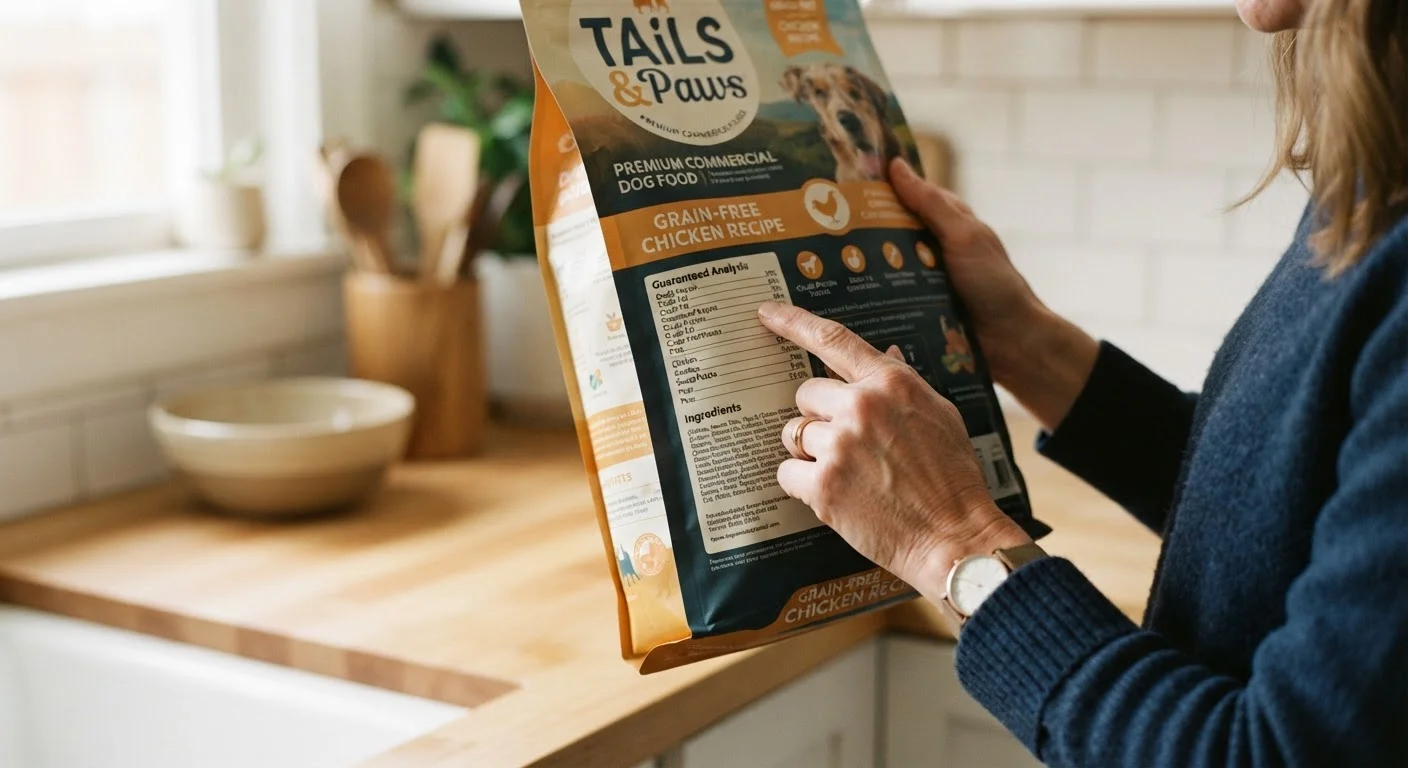
Ingredients are listed in descending order by pre-processing weight. Named protein sources - 'chicken,' 'beef,' 'salmon' - near the top are generally positive indicators. Be aware that 'meat meal' (e.g., 'chicken meal') is a concentrated, already-dried protein source that delivers more protein per pound than fresh meat. The ingredient list can help you identify potential allergens or fillers, but it doesn't tell you nutrient quality or digestibility on its own.
3. Guaranteed Analysis
This panel shows minimum crude protein, minimum crude fat, maximum crude fiber, and maximum moisture. These are not exact values - 'minimum 26% protein' means at least that amount, possibly more. Comparing guaranteed analysis across foods, especially between wet and dry, requires converting to a dry-matter basis, since moisture content dramatically affects how percentages appear. Dry vs. wet food comparisons cover this distinction in more depth.
4. AAFCO Nutritional Adequacy Statement
This is arguably the most important line on the label. It will state something like: ' is formulated to meet the nutritional levels established by the AAFCO Dog Food Nutrient Profiles for all life stages.' Look for the life stage (puppy/kitten, adult, senior, all life stages) and the validation method (formulated to meet profiles, or substantiated by feeding trials). If no adequacy statement appears, the food is not intended as a complete diet.
5. Feeding Guidelines and Manufacturer Information
Feeding guidelines are starting estimates based on average animals. They should be treated as a baseline and adjusted based on your pet's body condition score - a measure your veterinarian can assess during routine visits. The manufacturer's contact information is required on all labels, which allows you to ask questions about sourcing, quality control, or recalls directly.
Use Dry-Matter Basis for Fair Comparisons
When comparing wet and dry pet foods, guaranteed analysis percentages are not directly comparable because moisture levels differ dramatically. To make a fair comparison, subtract the moisture percentage from 100 to get the dry matter percentage, then divide the nutrient value by that number. Your veterinarian or a veterinary nutritionist can walk you through this calculation if needed.
What Labels Don't Tell You - and Where to Go Next
Labels provide regulated minimums and required disclosures, but they don't convey ingredient quality, sourcing standards, digestibility, or palatability. Two foods with identical guaranteed analyses can differ significantly in how well a pet absorbs and uses those nutrients. This is where veterinary guidance and your pet's individual response - coat condition, energy level, stool quality, body weight - become important signals.
Overfeeding is a common consequence of misreading feeding guidelines, and it carries real long-term health consequences. Our article on why portion size matters explains how improper amounts affect weight and joint health over time. If your pet takes supplements alongside their commercial diet, it's also worth reviewing what veterinary guidance says about pet supplementation - nutrients already present in a complete diet can reach harmful levels when added through supplements.
For pets with diagnosed health conditions, food sensitivities, or life-stage transitions (pregnancy, growth, senior years), label-reading is a starting skill, not a finishing one. Work with your veterinarian to identify foods that meet your pet's specific clinical needs. General label literacy helps you ask better questions and evaluate recommendations - it doesn't replace professional guidance.
This article provides general educational information about pet food labels and is not a substitute for personalized veterinary advice. Always consult a licensed veterinarian for guidance tailored to your specific pet's health and dietary needs.