
The Core Question: What Actually Moves the Needle?
Most people have felt the pull of both camps. There's the appeal of an intense workout that leaves you spent - proof that you worked hard. And there's the quieter satisfaction of a consistent routine maintained over months. The question isn't which feels more productive; it's which one actually delivers measurable health improvements over time.
Research on exercise, sleep, nutrition, and stress consistently points toward one overarching finding: the body adapts to what it experiences repeatedly, not what it experiences once at maximum effort. Physiological changes - improved cardiovascular function, better insulin sensitivity, stronger muscles, lower baseline cortisol - are driven by accumulated stimulus, not isolated peaks.
That said, intensity isn't irrelevant. The real question is how these two levers interact, and how much weight each deserves depending on the health domain you're targeting. For a broader look at how your current habits measure up, the daily wellness audit offers a useful starting framework.
How Consistency and Intensity Compare Across Key Health Areas
The balance between these two approaches plays out differently depending on whether you're thinking about exercise, sleep, nutrition, or stress. Here's how they stack up across each domain.
| Health Domain | Consistency Approach | Intensity Approach | |
|---|---|---|---|
| Exercise | Builds durable baseline fitness | Drives performance adaptations with recovery | |
| Sleep | Stabilizes circadian rhythm and restoration | Limited benefit; irregular long sleep doesn't compensate | |
| Nutrition | Gradual shifts become lasting habits | Crash diets often unsustainable; short-term only | |
| Stress Management | Daily practices lower baseline cortisol | Occasional intensive retreats offer short-term relief | |
| Injury/Burnout Risk | Lower - sustainable effort protects recovery | Higher without structured rest and progression | |
| Long-Term Adherence | Higher - lower barrier to daily follow-through | Lower - difficulty drives dropout over time |
As the table illustrates, consistency holds an advantage in most health domains, particularly those governed by the body's internal rhythms. Intensity earns its place in structured exercise - but even there, recovery (a consistency-adjacent concept) is what allows adaptations to take hold. See signs your body may need more recovery time for a closer look at when rest outperforms effort.
Exercise: Where Intensity Has Its Strongest Case
Exercise is the one domain where intensity has well-documented benefits that go beyond what low-effort consistency alone can deliver. High-intensity interval training (HIIT), resistance training at meaningful loads, and progressive overload all produce adaptations - including increased muscle mass, improved VO2 max, and stronger bones - that moderate daily movement doesn't fully replicate.
But here's the catch: those adaptations require recovery to materialize. A hard training session creates the stimulus; sleep, nutrition, and rest days create the result. Without consistent recovery habits surrounding intense sessions, the body doesn't adapt - it just accumulates fatigue.
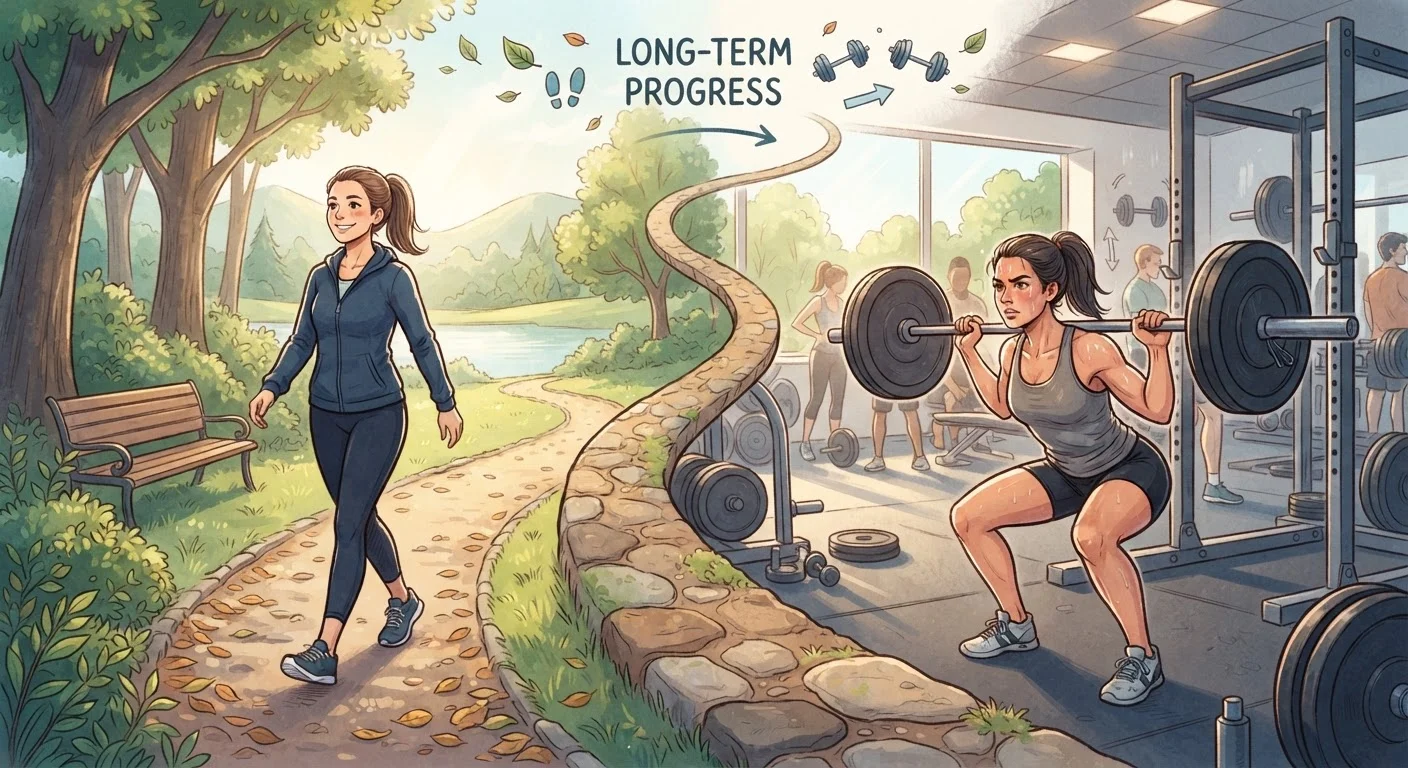
For most people who aren't competitive athletes, a realistic framework looks like this: build a consistent movement baseline first (daily walking, regular activity), then layer in two or three higher-intensity sessions per week. What happens to your body when you start exercising regularly walks through the physiological timeline of exactly this kind of progression.
Build the Habit Before You Raise the Bar
If you're new to structured exercise or returning after a gap, resist the urge to start at high intensity. Establishing a consistent schedule - even at moderate effort - for four to six weeks first makes it far more likely the habit will stick. Once showing up feels automatic, gradually increasing intensity becomes much easier to sustain.
Small-movement habits throughout the day also contribute meaningfully to your overall activity load - making consistency easier to maintain even on days when a structured workout isn't possible.
Sleep, Diet, and Stress: Where Consistency Dominates
Outside of structured exercise, consistency is the clear frontrunner. Sleep quality is a prime example: your body's circadian system is built around predictable timing. Going to bed and waking at roughly the same times each day strengthens the internal clock signals that govern sleep depth, hormone release, and cellular repair. Occasional long sleep sessions on weekends don't meaningfully compensate for chronic irregular patterns - a concept researchers sometimes call "social jet lag." For practical strategies, building a sleep habit that works for your schedule covers how to anchor sleep routines even with an imperfect calendar.
Nutrition follows the same logic. Dramatic dietary overhauls tend to fail because they rely on sustained willpower rather than ingrained habit. The evidence strongly favors incremental, consistent dietary shifts - adding a serving of vegetables, reducing ultra-processed snacks gradually - over periodic clean-eating sprints. Nutrition habit-building without overhauling your entire diet makes a compelling case for this approach.
Stress management works similarly. Daily micro-practices - brief breathing exercises, short walks, consistent sleep - do more to regulate the nervous system over time than occasional intensive retreats. What chronic stress does to your body over time explains why unaddressed accumulation is the real threat, and why regularity in coping practices matters so much.
Why Habit Sustainability Trumps Peak Effort
The strongest argument for prioritizing consistency over intensity isn't philosophical - it's behavioral. Research on habit formation and exercise adherence consistently shows that people abandon high-intensity programs far more often than moderate, sustainable ones. Intensity raises the barrier to entry on any given day. A 20-minute moderate walk is easier to do tired, stressed, or short on time than a demanding workout - and doing something regularly beats doing something perfect occasionally.
Why people quit exercise programs examines the dropout patterns in detail, and the evidence points toward perceived difficulty and time commitment as the primary culprits. Reducing intensity early in a habit-building phase increases the likelihood of showing up consistently - which is precisely what drives long-term gains.
The practical takeaway: start with the frequency and routine that feel genuinely manageable. Once consistency is established - typically over several weeks - intensity can be gradually increased without threatening the habit's stability. This is the approach most likely to deliver meaningful, lasting health improvements for everyday Americans.
This article is for general informational and educational purposes only and does not constitute medical advice. Always consult a qualified healthcare professional before making changes to your exercise, diet, or wellness routines, especially if you have an existing health condition.