Why Enrichment Looks Different at Every Life Stage
Enrichment isn't a one-size-fits-all concept. A puzzle feeder that challenges and excites a curious puppy may frustrate a senior dog with arthritis in their paws. A feather wand that sends a young cat into a frenzy might overwhelm a timid rescue adult who missed early socialization. Understanding where your pet is in their life - cognitively, physically, and emotionally - is the foundation of effective enrichment.
Veterinary behaviorists generally define enrichment as any activity or environmental modification that stimulates natural behaviors, reduces stress, and promotes psychological wellbeing. For pet owners, that translates into practical choices made every day: what you offer, how long sessions last, and how you read your pet's signals.
The list below organizes enrichment strategies by life stage so you can meet your pet where they are. Whether you have a high-energy puppy, a settled adult, or a slower-moving senior, there's a meaningful way to keep them engaged. These ideas apply broadly to dogs and cats - and many translate to small mammals and other companion animals as well. For a broader view of how your pet's environment shapes their wellbeing, see our guide on indoor vs. outdoor pet living.
Puppies and Kittens: Sensory Exploration First
Young pets are wired to explore everything - smells, textures, sounds, and movement. During this critical developmental window, enrichment should prioritize safe sensory exposure over complexity. Introduce a variety of surfaces (grass, tile, carpet), gentle sounds, and novel objects in short, positive sessions.
For puppies, basic lick mats with soft food, simple hide-and-seek games with treats, and age-appropriate tug toys build confidence while tiring out a busy brain. For kittens, crinkle balls, tunnels, and wand toys mimic prey behavior and channel natural hunting instincts. Keep sessions brief - five to ten minutes - since young pets fatigue mentally faster than their boundless energy suggests.
Early enrichment also lays the groundwork for social confidence later. Pets who didn't get this exposure may need a more gradual approach; our guide on socializing pets that missed early development covers that process in detail.
Young pets need safe sensory variety, not complexity, to build confidence and cognitive skills.
Adolescent Pets: Channel High Energy Constructively
The adolescent phase - roughly six months to two years depending on species and breed - is often the most behaviorally challenging. Energy peaks, impulse control is still developing, and boredom leads directly to destructive behavior. This is the stage where enrichment must be both physically tiring and mentally demanding.
Structured training sessions (five to fifteen minutes, two to three times daily) are among the most effective enrichment tools for adolescents. Teaching new cues, trick sequences, or scent-discrimination tasks requires focused mental effort. Pair training with physical outlets: fetch, agility work, or leash-based exploration for dogs; climbing structures, interactive wand sessions, and prey-simulation toys for cats.
Rotating toys every few days maintains novelty. If the same toy is always available, it quickly loses appeal. A simple rotation schedule costs nothing and dramatically extends engagement.
Structured training sessions are among the most mentally demanding enrichment tools for adolescent pets.
Adult Pets: Deepen Skills and Vary Challenges
Adult pets in their prime benefit from enrichment that builds on established skills rather than starting from scratch. This is the ideal stage to introduce more sophisticated puzzle feeders, multi-step training behaviors, and nose-work games that require sustained concentration.
Scent work is particularly underutilized for adult dogs. Teaching a dog to identify and alert to a specific odor hidden around the house provides fifteen to twenty minutes of intense mental engagement - often more tiring than a physical walk. For cats, foraging-style feeders that require pawing or rolling to release food tap into natural predatory sequences.
Social enrichment also matters at this stage. Appropriate dog-to-dog play, supervised exploration of new environments, or even window perches with bird feeders visible outside can meaningfully reduce boredom-related stress in cats who are primarily indoors.
Nose-work games can tire an adult dog more effectively than a physical walk alone.
Senior Pets: Adapt, Don't Abandon, Enrichment
One of the most common mistakes owners make is scaling back enrichment entirely as pets age. In reality, older pets often need cognitive stimulation more than ever to support brain health - but the form of that stimulation must change to match physical limitations.
For senior dogs, swap high-impact play for gentle nose-work, slow sniff walks where the dog sets the pace, and soft food puzzles that don't require strength or dexterity. For senior cats, low-height climbing options, bird-watching setups, and short, gentle wand sessions at their level keep the mind active without stressing aging joints.
Watch for signs of cognitive dysfunction - disorientation, changed sleep patterns, or reduced interest in interaction - and discuss these with your veterinarian. Enrichment can support mental health, but it is not a substitute for veterinary evaluation of age-related changes.
Older pets benefit most from low-impact enrichment that challenges the mind without straining the body.
DIY Enrichment: Effective Options That Cost Little
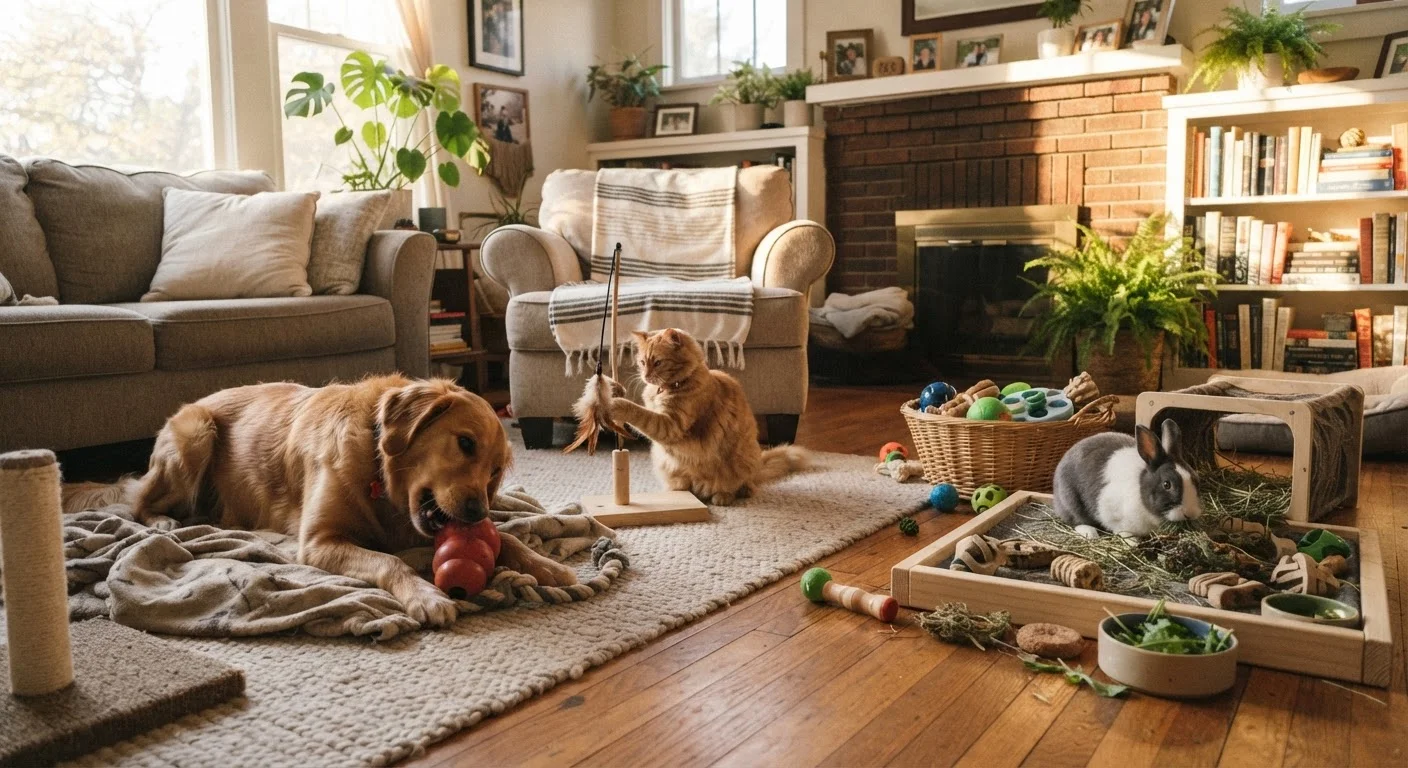
Enrichment doesn't require a significant financial investment. Some of the most effective options use items already in most households. Muffin tins with tennis balls hiding treats challenge dogs to problem-solve. Paper bags and cardboard boxes stuffed with crinkled paper and a few treats create foraging opportunities for cats. Frozen broth cubes or stuffed rubber toys kept in the freezer extend mealtime engagement for dogs.
For small mammals like rabbits or guinea pigs, paper towel rolls filled with hay and folded at the ends, or cardboard tunnels arranged into simple mazes, meet foraging instincts effectively. The key principle is replicating natural behaviors - searching, hunting, foraging - in a safe, supervised setting.
Keeping enrichment costs manageable fits naturally into responsible pet ownership financial planning, where everyday care decisions add up over a pet's lifetime.
Household items like muffin tins and cardboard boxes can deliver effective enrichment at no extra cost.
Reading Your Pet's Enrichment Signals
Even the best-designed enrichment activity fails if the pet isn't ready for it - or if the session goes too long. Learning to read engagement signals helps owners calibrate effectively. Signs of positive engagement include relaxed, focused body language, voluntary return to the activity, and a calm but alert demeanor afterward.
Signs that an activity is too difficult, overstimulating, or simply unappealing include avoidance, frustration behaviors (pawing roughly, walking away repeatedly), or excessive panting and vocalization in dogs. These signals are information, not failure. Adjust difficulty, duration, or the activity type and try again.
Enrichment should end on a positive note - before the pet loses interest, not after. Short, successful sessions build confidence and reinforce the habit for both pet and owner.
Always end enrichment sessions before your pet loses interest, not after - success builds the habit.
Making Enrichment a Sustainable Daily Habit
The most effective enrichment isn't elaborate - it's consistent. A five-minute nose-work session each morning, a food puzzle at dinnertime, or a short training round before bed adds up to meaningful daily stimulation without overwhelming your schedule. Building a predictable daily routine makes it easier to weave these activities in naturally, and pets thrive when they know what to expect.
As your pet ages, revisit and adjust. What worked at two years old may need modification at ten. Your veterinarian is your best resource for identifying when physical or cognitive changes call for a different enrichment approach - especially for senior animals whose health needs shift considerably with age. You can also incorporate enrichment tracking into a monthly pet care checklist to stay consistent across all aspects of responsible ownership.
Start Small and Build Gradually
If your pet is new to structured enrichment, introduce one activity at a time over a week before adding another. Overwhelming a pet with too many novel experiences at once can cause stress rather than stimulation. A single five-minute puzzle session per day is a meaningful starting point that you can build on as your pet gains confidence and skill.
This article provides general pet care information for educational purposes. Always consult a licensed veterinarian for guidance specific to your individual pet's health, behavior, or developmental needs.