Why These Three Asset Classes Matter
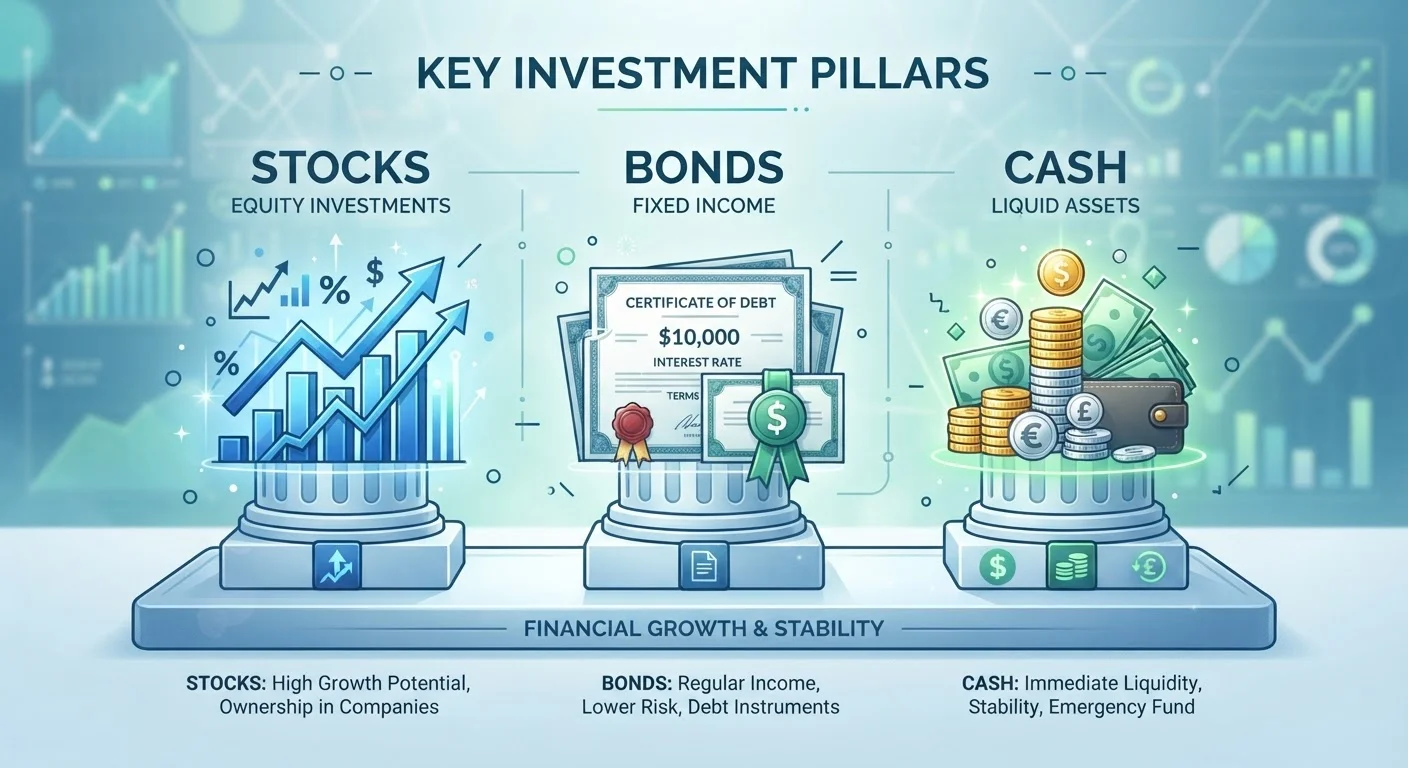
Every investment portfolio, no matter how simple or complex, is built from some combination of three core ingredients: stocks, bonds, and cash. Understanding what each one is - and how it tends to behave - gives beginners a framework for making sense of almost any investment account they'll encounter.
These categories are called asset classes: groups of investments that share similar characteristics and respond to market conditions in broadly similar ways. Because they don't all move in the same direction at the same time, holding a mix can help manage risk. That's the foundation of diversification - a concept worth understanding alongside these basics.
This article is general financial information and education, not personalized investment advice. For decisions specific to your situation, consult a licensed financial professional.
Asset Class
A broad category of investments with similar characteristics and behaviors. Stocks, bonds, and cash are the three primary asset classes most investors encounter.
Stock (Equity)
A share of ownership in a company. Stockholders may benefit if the company grows in value, but also bear the risk of loss if it declines.
Bond
A debt instrument through which an investor loans money to a government or corporation in exchange for regular interest payments and the return of principal at maturity.
Liquidity
How quickly and easily an asset can be converted to cash without significantly affecting its value. Cash and money market funds are highly liquid; real estate is not.
Volatility
The degree to which an investment's price fluctuates over time. Higher volatility means larger and more frequent price swings, which represents greater short-term risk.
Coupon
The regular interest payment paid to a bondholder by the bond issuer, typically expressed as a percentage of the bond's face value.
Stocks: Ownership With Growth Potential - and Risk
When you buy a stock (also called a share or equity), you're purchasing a small ownership stake in a company. If the company grows and becomes more valuable, your shares typically rise in value. If it struggles, your investment can fall - sometimes sharply.
Stocks have historically delivered higher long-term returns than bonds or cash, but that potential comes with greater short-term volatility. A stock's price can swing significantly based on earnings reports, economic news, or broader market sentiment. Investors who can tolerate this volatility and hold over long time horizons have generally been rewarded, though past performance never guarantees future results.
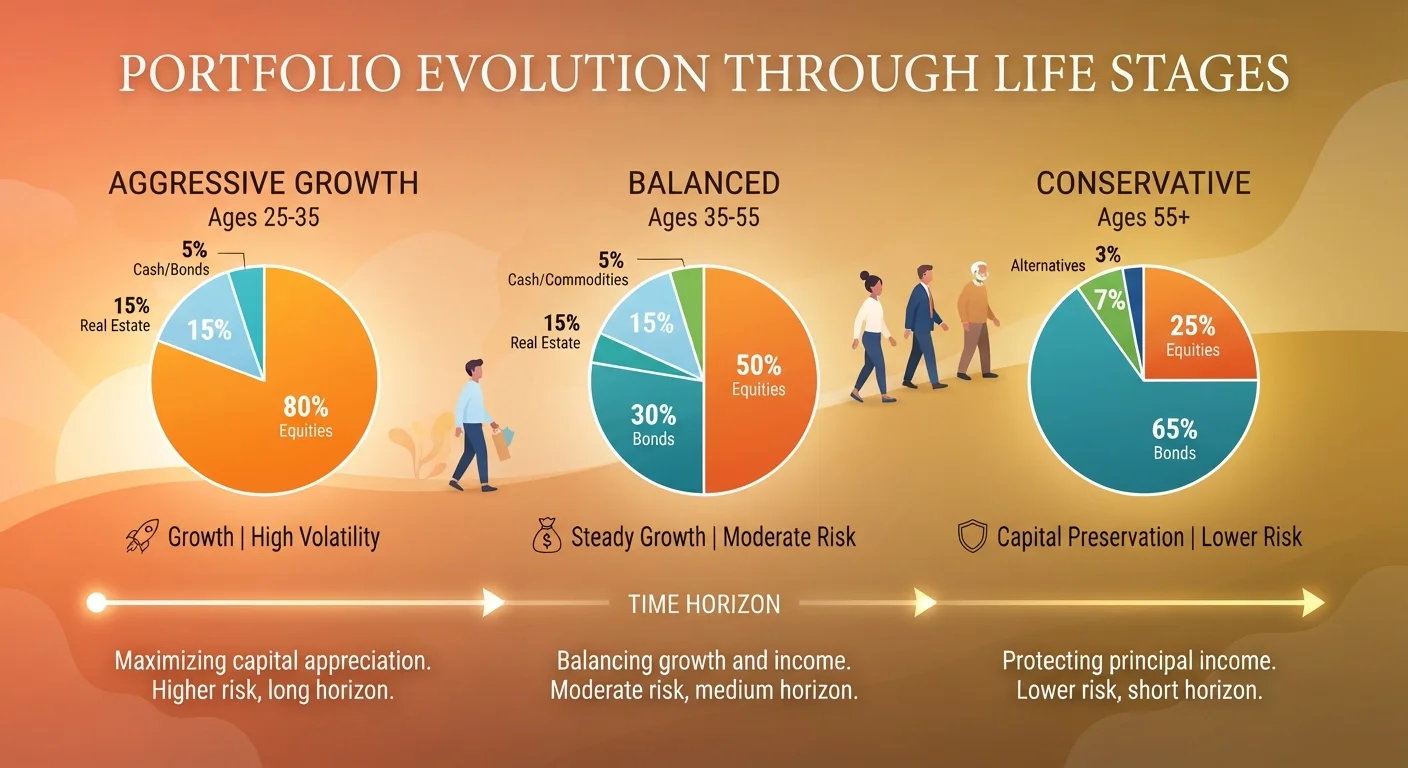
Stocks are particularly central to growth-oriented portfolios - especially for younger investors with decades before they'll need to draw on their savings. As covered in how portfolio mix shifts over time, the proportion of stocks in a portfolio often decreases as someone approaches retirement.
| Primary purpose of stocks | Long-term growth through company ownership |
| Primary purpose of bonds | Income and portfolio stability through lending |
| Primary purpose of cash | Liquidity, safety, and short-term needs |
| Risk level (general order) | Cash (lowest) → Bonds → Stocks (highest) (General financial principle; individual securities vary) |
| Return potential (general order) | Cash (lowest) → Bonds → Stocks (highest historically) (Past performance does not guarantee future results) |
| Bond price and interest rates | Move in opposite directions (inverse relationship) |
Bonds: Lending Money for Predictable Income
A bond is essentially a loan you make to a government, municipality, or corporation. In exchange, the borrower agrees to pay you regular interest (called a coupon) and return your principal when the bond matures. Bonds are generally considered lower-risk than stocks, though they're not risk-free - bond prices can fall when interest rates rise, and a borrower can default.
Because bonds tend to be more stable than stocks and provide predictable income, they're often used to add ballast to a portfolio. When stock markets fall sharply, bonds frequently (though not always) hold their value better or even appreciate, which can cushion overall losses.
The tradeoff: bonds typically offer lower long-term returns than stocks. They serve a different purpose - stability and income rather than maximum growth. Understanding this tradeoff helps explain why portfolio construction isn't about picking the "best" asset class, but about finding a balance suited to your goals and timeline.
Cash and Cash Equivalents: Safety and Liquidity
"Cash" in an investment context includes more than dollar bills - it encompasses savings accounts, money market funds, Treasury bills, and certificates of deposit (CDs). What these share is high liquidity (you can access the money quickly) and low risk of losing your principal.
The downside is modest return. Cash rarely keeps pace with inflation over long periods, meaning its purchasing power can erode quietly over time. For this reason, large amounts held in cash for years can actually represent a hidden cost.
That said, cash plays essential roles: as an emergency fund, as a buffer for near-term expenses, and as "dry powder" an investor keeps available to deploy when opportunities arise. Most financial professionals recommend keeping three to six months of living expenses in liquid, accessible savings before focusing heavily on investing - a concept explored further in our saving and debt guidance.
3-6 months
Recommended liquid emergency fund
Most financial planning frameworks suggest holding three to six months of expenses in accessible cash or cash equivalents before investing aggressively.
~10%
U.S. stock market average annual return (historical)
The broad U.S. stock market has averaged roughly 10% annually before inflation over long historical periods - but with significant year-to-year variation and no guarantee of future results.
3
Core asset classes in most portfolios
Stocks, bonds, and cash equivalents form the foundation of the vast majority of individual and institutional investment portfolios worldwide.
Putting It Together: How the Three Work as a System
No single asset class is universally superior. Stocks offer growth with volatility. Bonds offer stability with lower returns. Cash offers safety with minimal growth. A portfolio that holds all three in proportions suited to an investor's timeline, goals, and risk tolerance is more resilient than one that concentrates entirely in any single class.
The right mix is personal. A 25-year-old saving for retirement decades away can typically afford more exposure to stocks. Someone approaching retirement may shift toward more bonds and cash to protect what they've built. These are general principles - not prescriptions. Starting to invest on any income is more achievable once you understand these building blocks and how they can work together over time.
Watch for behaviors that can undermine even a well-structured portfolio, such as panic selling during downturns - covered in detail in our guide on early investing pitfalls. And consider that where you hold these assets - in a taxable account versus a tax-advantaged one - matters as much as what you hold. Tax-advantaged accounts can significantly affect long-term outcomes.
This article is for general informational and educational purposes only and does not constitute personalized financial, investment, or tax advice. Consult a qualified financial professional before making investment decisions.
Asset Classes Are Starting Points, Not Formulas
Within each asset class, there's enormous variety. Not all stocks behave the same - large, established companies tend to be more stable than small, emerging ones. Not all bonds carry equal risk - U.S. Treasury bonds are considered among the safest, while high-yield ("junk") bonds carry significantly more risk. Understanding the broad categories is the first step; digging into the specifics of each comes next. Always consider consulting a licensed financial adviser before making investment decisions.