Why Asset Allocation Evolves Over Time
Asset allocation - how you divide a portfolio among stocks, bonds, cash, and other asset classes - is one of the most consequential decisions an investor makes. It isn't a one-time choice; it's a framework that should evolve as your financial situation, income, and timeline change.
The core logic is straightforward: growth-oriented assets like stocks carry higher short-term risk but greater long-term reward potential. Stability-oriented assets like bonds or cash equivalents carry lower risk but also lower growth potential. The right balance depends largely on how much time you have before you need the money and how much volatility you can realistically tolerate without abandoning your plan.
Understanding how compound interest builds wealth over time makes it clear why starting growth-focused early carries such lasting advantages.
90%
Portfolio performance explained by asset allocation
Research published in the Financial Analysts Journal suggests that asset allocation policy explains roughly 90% of the variability in a portfolio's returns over time.
20-30 years
Typical length of a modern retirement
According to Social Security Administration actuarial data, a 65-year-old today can expect to live, on average, into their mid-80s - making long retirement horizons a real planning challenge.
Early Career: Prioritizing Long-Term Growth
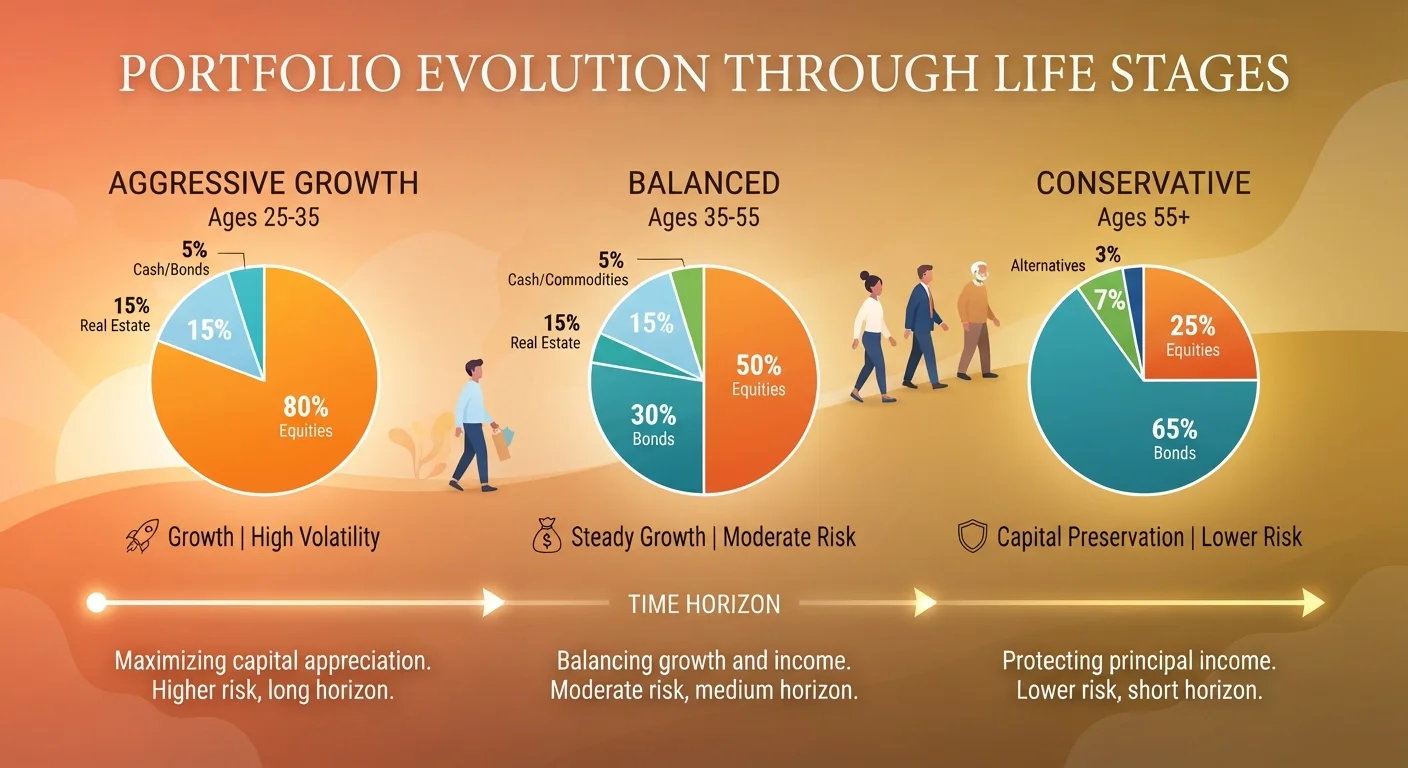
Investors in their 20s and early 30s typically have the greatest asset on their side: time. A portfolio with decades of runway can ride out market downturns, making it generally appropriate to hold a higher proportion of stocks - often cited in the range of 80-90% equities for those in their 20s, though this varies by individual circumstances.
With a longer horizon, temporary market declines are less threatening because a portfolio has years to recover. This stage is also when investing on a regular schedule becomes a powerful discipline - contributing consistently through market swings takes emotion out of timing decisions.
Common pitfalls at this stage include being too conservative out of fear, or chasing performance with poorly diversified choices. See our guide to early investing pitfalls for behaviors that quietly erode returns over time.
Match your equity exposure to your time horizon, not just your comfort level.
Investors sometimes hold too little in stocks out of short-term anxiety, sacrificing decades of compounding potential. Time horizon is the most reliable guide to how much risk a portfolio can realistically absorb.
Rebalance your portfolio at least once a year, not only at life milestones.
Market movements naturally drift your allocation away from its target over time. Without rebalancing, a strong equity run can leave you overexposed to risk you didn't intend to carry.
Adjust allocation gradually, not all at once, as you approach major transitions.
Abrupt shifts in portfolio composition can trigger unnecessary tax events, lock in poor timing decisions, or remove growth potential prematurely. Gradual adjustment smooths the transition.
Consider your full financial picture - not just investment accounts - when setting allocation.
A pension, rental income, or significant cash savings already provides stability, which may justify holding more equities in investment accounts. Treating accounts in isolation can lead to misaligned overall risk.
Use low-cost, diversified funds as building blocks rather than individual securities.
Broad market index funds reduce the risk of concentrated losses in individual stocks and keep costs low - a factor that compounds significantly over decades. See how index funds compare to actively managed alternatives in cost and historical performance.
Mid-Career and Pre-Retirement: Gradual Rebalancing
Through your 40s and into your 50s, the calculus shifts. You likely have more accumulated wealth to protect, and your recovery runway is shorter. A common general principle - sometimes expressed as holding a bond percentage roughly equal to your age - is a useful starting point, though many financial planners consider it too conservative for today's longer retirements.
A more common modern approach tilts toward maintaining substantial equity exposure (perhaps 60-70%) well into your 50s, gradually reducing it as retirement nears. The goal is slowing the shift, not stopping growth entirely.
“The most important decision in investing isn't which stocks to pick - it's deciding how much of your portfolio to put in stocks versus bonds in the first place.”
— Burton Malkiel, Economist and author of 'A Random Walk Down Wall Street'
Diversification across asset classes becomes especially important here - spreading exposure beyond just U.S. stocks into international equities, bonds, and real assets can reduce the impact of any single market downturn on a portfolio you've spent decades building.
Don't Neglect Your Emergency Fund First
Before optimizing portfolio allocation, ensure you have a liquid emergency fund covering three to six months of essential expenses. Investing money you may need in the near term forces poorly timed withdrawals that undermine long-term strategy. For foundational guidance on balancing savings and debt, see the Saving & Debt hub.
Retirement: Balancing Income Needs With Longevity Risk
Entering retirement doesn't mean shifting entirely to cash and bonds. With retirements commonly lasting 20-30 years, a portfolio that grows too slowly may not sustain withdrawals over the long term. Most financial planning frameworks suggest retirees still hold a meaningful equity component - often 40-60% depending on individual needs and risk tolerance.
The practical priority shifts from accumulation to distribution: generating reliable income while preserving capital. Many retirees use a "bucket" approach - keeping near-term expenses in stable, low-risk assets while leaving longer-horizon funds invested in equities for continued growth potential.
Target-date funds, offered through many workplace retirement plans, automate this entire lifecycle by gradually shifting their allocation mix as the target year approaches. They're not a perfect fit for everyone, but they remove the burden of manual rebalancing for investors who prefer a hands-off approach. Consult a licensed financial adviser to evaluate which approach fits your specific situation and retirement income needs.
This article is for general informational and educational purposes only and does not constitute personalized financial, investment, or tax advice. Consult a qualified financial professional before making decisions about your own portfolio.