The Core Logic: Don't Put All Your Eggs in One Basket
The old saying maps almost perfectly onto investing. When all of your money sits in a single stock, bond, or sector, your financial wellbeing is entirely at the mercy of that one investment's performance. A single bad earnings report, a regulatory change, or an industry disruption can wipe out a significant share of your savings overnight.
Diversification counters that concentration risk by spreading capital across investments that don't all move in the same direction at the same time. When two assets are uncorrelated - meaning their prices don't rise and fall together - a loss in one is more likely to be offset, at least partially, by stability or gains in the other.
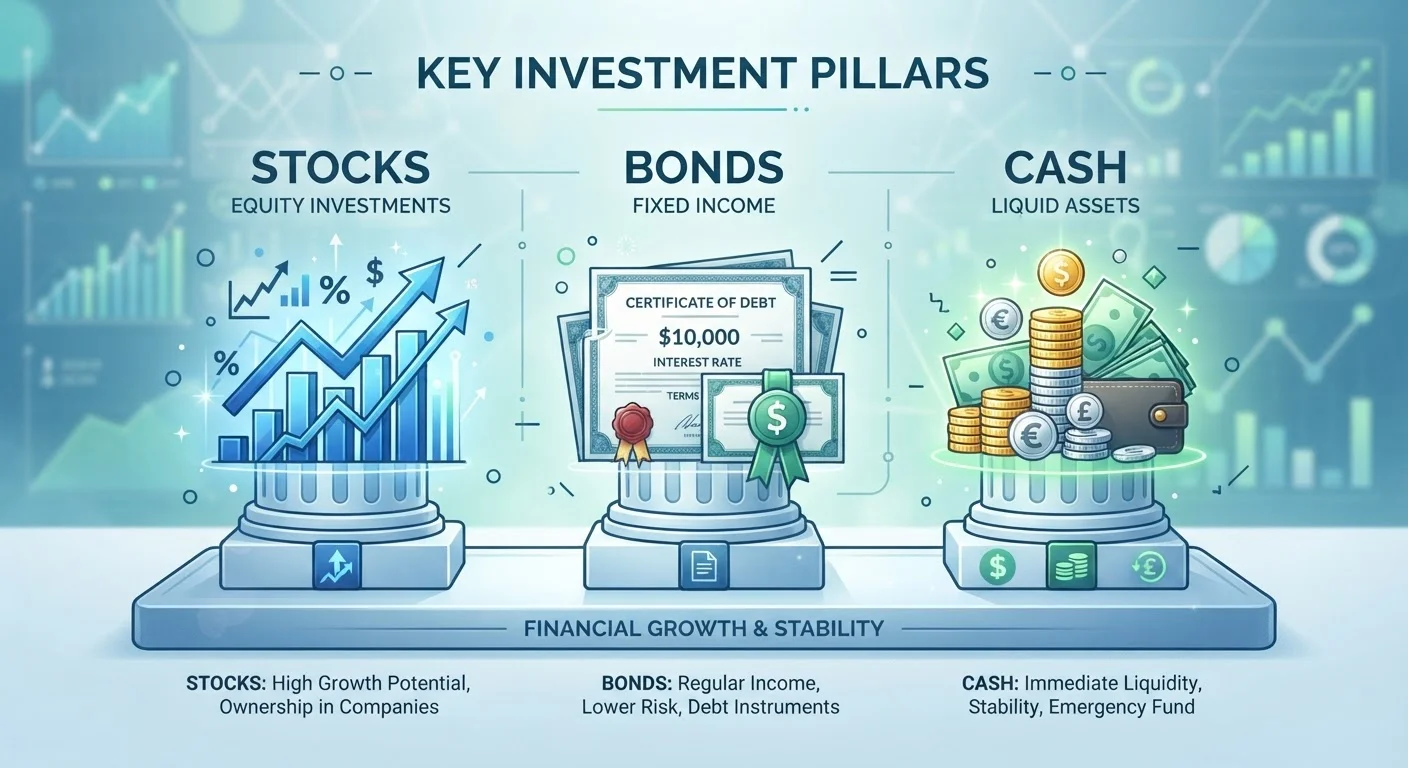
This is not just theory. It's a principle embedded in how most professionally managed portfolios and retirement funds are constructed. Understanding it is a foundational step toward thinking clearly about your own financial future. See our overview of stocks, bonds, and cash to understand how the major asset classes behave differently under various conditions.
~20
Stocks often cited to reduce unsystematic risk significantly
Academic research in portfolio theory, including foundational work by Elton and Gruber, suggests that much of the benefit of diversification can be captured by holding around 20 uncorrelated stocks - though broader exposure across sectors and geographies adds further resilience.
Over 3,500
Securities in a typical broad U.S. total-market index fund
Broad-market index funds commonly track thousands of individual securities across sectors and company sizes, offering individual investors a level of diversification that would be impractical to replicate by picking individual stocks.
How Diversification Works in Practice
Diversification can be applied at several levels simultaneously:
- Across asset classes: Holding a mix of stocks, bonds, and cash means that when stocks decline sharply, bonds may hold their value or appreciate - they have historically shown a tendency to move differently from equities, though this relationship varies over time.
- Within asset classes: Owning shares in dozens of companies across different industries (technology, healthcare, consumer goods, energy) means a downturn in one sector has limited reach across the rest of your holdings.
- Across geographies: Investing in both domestic and international markets adds another layer, so a slowdown in one country's economy doesn't define your entire return.
For many everyday investors, broad-market index funds or exchange-traded funds (ETFs) offer a practical path to this kind of spread. A single fund tracking a broad market index can hold hundreds or thousands of individual securities, providing wide diversification with relatively low complexity and cost.
What Diversification Can and Cannot Do
It's worth being precise about the limits of diversification. Financial professionals distinguish between two types of risk:
- Unsystematic risk
- Risk specific to a single company, industry, or sector. This is the type diversification can meaningfully reduce. If one company in your portfolio fails, a diversified portfolio absorbs that loss across many other holdings.
- Systematic risk
- Risk that affects the entire market - economic recessions, global financial crises, sudden interest rate shifts. Diversification cannot protect against these events because nearly all assets tend to decline together during broad market stress.
This distinction matters because some investors assume a diversified portfolio is a safe portfolio in all conditions. It is a more resilient portfolio - but it is not immune to loss, and setting realistic expectations is part of investing responsibly.
“Diversification is the only free lunch in investing. By combining assets that don't move in lockstep, you can reduce risk without necessarily sacrificing expected return.”
— Harry Markowitz, Nobel Prize-winning economist and pioneer of Modern Portfolio Theory
For a closer look at behaviors that erode long-term returns - including the tendency to panic-sell during downturns - see our piece on early investing pitfalls.
Building a Diversified Approach Over Time
Diversification is not a one-time event. As your financial situation evolves, so should your portfolio's composition. Investors who are decades from retirement typically hold a higher proportion of growth-oriented assets like stocks, accepting more short-term volatility in exchange for long-term potential. Those approaching retirement often shift toward more stable, income-generating assets to protect accumulated wealth.
Pairing diversification with a strategy like dollar-cost averaging - investing fixed amounts at regular intervals - can further reduce the risk of investing a large sum at the wrong moment in the market cycle. Together, these approaches form the basis of disciplined, long-term investing for most everyday consumers.
Review Your Holdings for Hidden Concentration
Even investors who think they are diversified can have hidden concentration. If multiple funds in your portfolio hold the same large-cap stocks heavily, your actual exposure may be far less spread out than it appears. Checking the underlying holdings of any fund you own is a worthwhile step. A licensed financial adviser can help you assess whether your current allocation reflects your goals and risk tolerance.
To understand how the balance between growth and stability tends to shift across different life stages, see our guide on asset allocation across life stages.
This article is for general informational and educational purposes only and does not constitute personalized financial, investment, or tax advice. Consult a qualified, licensed financial adviser before making investment decisions suited to your individual circumstances.