
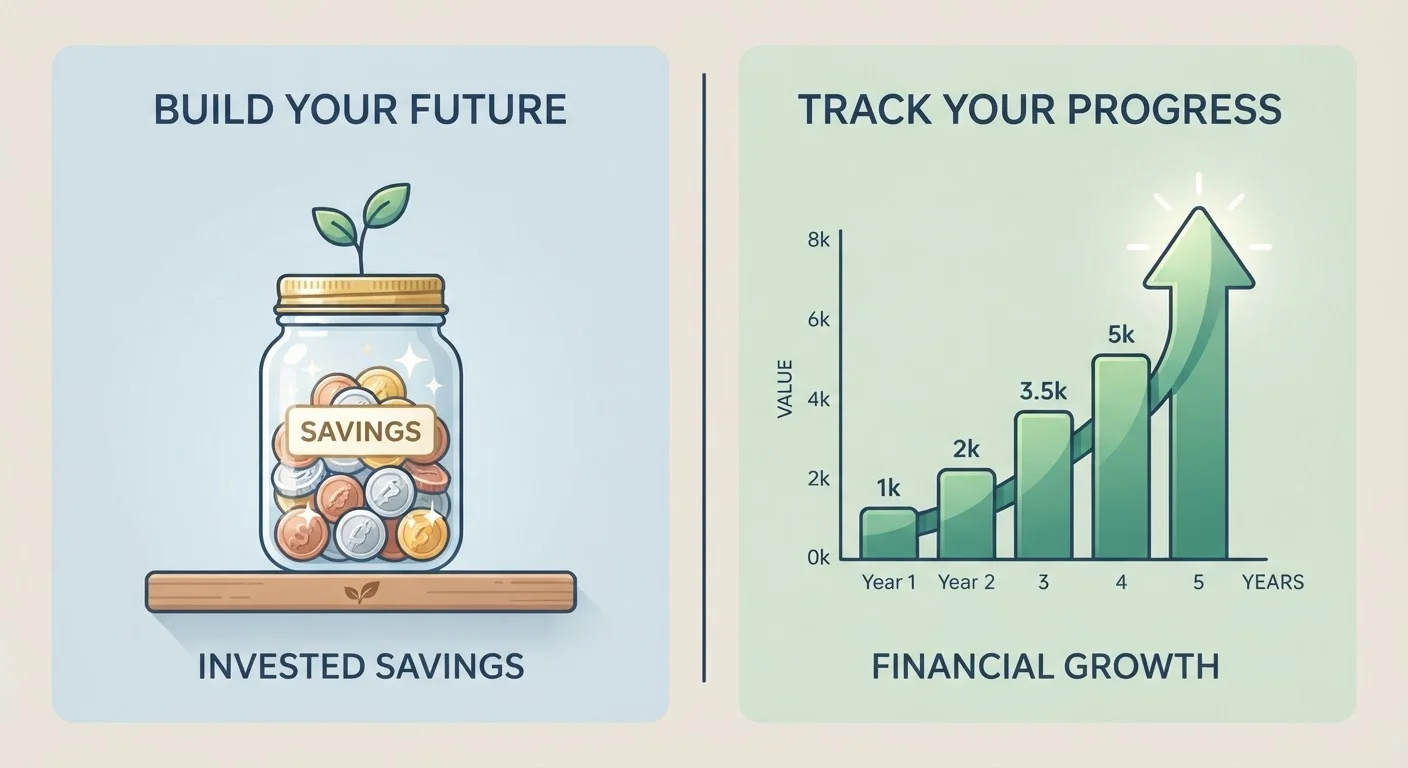
Two Tools, Two Jobs
Most people treat saving and investing as points on a single spectrum - do more of one when you're cautious, more of the other when you're confident. That framing misses the point. Saving and investing are fundamentally different financial tools designed to solve different problems.
Saving is the act of setting aside money in a low-risk, accessible account - typically a savings account, money market account, or certificate of deposit. The goal is to preserve your principal (the original amount you deposited) and ensure the funds are available when you need them. Returns are modest, but the money is safe and liquid.
Investing means putting money into assets - such as stocks, bonds, or funds - with the expectation that they will grow in value over time. Returns can be substantially higher than savings rates, but so can losses. The key trade-off is accepting short-term volatility in exchange for long-term growth potential.
Neither approach is inherently superior. They serve different time horizons and fulfill different roles in a healthy financial life. For a broader look at common misunderstandings, see investing myths that keep people on the sidelines.
| Saving | Investing | |
|---|---|---|
| Primary purpose | Preserve capital; short-term access | Grow wealth over long term |
| Typical vehicles | Savings accounts, CDs, money markets | Stocks, bonds, mutual funds, ETFs |
| Risk to principal | Very low (FDIC insured up to limits) | Variable; can lose value |
| Return potential | Low to modest | Higher over long horizons |
| Liquidity | High - funds accessible quickly | Varies; selling may take time or incur loss |
| Best time horizon | Under 3 years | 5 or more years |
| Inflation protection | Weak - rates often below inflation | Stronger over long periods historically |
The Risk and Time Horizon Question
The single most important factor separating saving from investing is time horizon - how long before you'll need the money.
If you're building an emergency fund, saving for a car, or setting aside rent for next month, you cannot afford to lose that money. A market downturn the week before you need those funds would be devastating. That's why short-term money belongs in savings vehicles, where the principal is protected.
Long-term goals are different. If you're saving for retirement 25 years away, short-term market fluctuations matter far less. Historically, diversified investment portfolios have recovered from downturns over longer periods - though past performance does not guarantee future results. That longer runway lets you ride out volatility and potentially benefit from compounding growth over time.
Match Your Account to Your Goal's Timeline
Before putting money anywhere, ask yourself: when will I need this? Money needed within three years generally belongs in savings to protect against short-term market swings. Money you won't touch for five years or more is a candidate for investing, where time can work in your favor. Matching the account type to the timeline is one of the most practical habits in personal finance.
A commonly cited rule of thumb: if you'll need the money within three years, keep it in savings. If your timeline extends beyond five years and the loss of some principal wouldn't derail your finances, investing may be appropriate. The range in between warrants careful consideration of your personal risk tolerance and financial cushion.
For those managing both savings goals and existing debt, saving while in debt offers a practical framework for tackling both simultaneously.
Why Keeping Everything in Savings Has a Hidden Cost
Savings accounts feel safe - and for short-term money, they are. But holding all of your money in savings indefinitely carries its own risk: inflation.
Inflation is the gradual increase in the price of goods and services over time. When the annual inflation rate exceeds the interest rate on your savings account, your money's purchasing power declines each year, even as the account balance grows nominally. In other words, $10,000 sitting in a low-yield account for a decade may technically be worth more dollars but buy meaningfully less.
~3%
Average U.S. long-run annual inflation rate
The Federal Reserve targets 2% average inflation; actual long-run averages have generally ranged from 2-4%, quietly eroding the value of uninvested cash.
56%
Americans who own investments
According to Gallup's annual Economy and Personal Finance survey, roughly 56% of U.S. adults report owning stocks, often through retirement accounts.
This is why financial educators consistently note that long-term wealth building typically requires some form of investing. The potential returns from a diversified investment portfolio - while not guaranteed - have historically outpaced inflation over long periods in ways that savings accounts rarely match.
To understand which savings vehicles offer the most competitive short-term returns, high-yield savings accounts vs. money market accounts provides a detailed side-by-side comparison.
Building a Framework That Uses Both
For most people, the answer is not to choose saving or investing - it's to use both intentionally. A foundational framework looks something like this:
- Build a liquid emergency fund first. Most financial guidance suggests three to six months of essential expenses in an accessible savings account before directing significant money toward investments. This cushion ensures that a job loss or unexpected bill doesn't force you to liquidate investments at an inopportune time.
- Identify your goals by time horizon. Short-term goals (a vacation, a new appliance, a down payment within a few years) belong in savings. Long-term goals (retirement, financial independence) are candidates for investing.
- Understand account types. Tax-advantaged accounts like 401(k)s, IRAs, and HSAs can make investing more efficient by reducing your tax burden. Tax-advantaged accounts every beginning investor should understand is a useful primer on how these work.
- Start where you are. You don't need a large sum to begin investing. Investing on any income walks through how to begin regardless of your current financial position.
Automating contributions to both savings and investment accounts removes the friction of manual transfers. See automating your savings for practical approaches that help the habit stick.
This article is for general informational and educational purposes only and does not constitute personalized financial, investment, or tax advice. Please consult a qualified financial professional before making decisions specific to your circumstances.