What Unit Price Actually Tells You
When you pick up two bottles of olive oil - one 16 oz for $6.49 and one 32 oz for $11.99 - the sticker price alone doesn't tell you which is the better deal. Unit price does. It strips away the packaging and the marketing and reduces everything to a single, comparable number: what you're actually paying per ounce, per sheet, per tablet, or per load.
That number matters because stores sell the same product in a dizzying range of sizes, and the pricing between sizes is almost never proportional. A medium-sized laundry detergent isn't reliably half the price of the jumbo. A six-pack isn't always cheaper per can than a twelve-pack. Without unit pricing, your brain is left doing imprecise estimates at the shelf - which is exactly the environment retailers design for.
Unit pricing is also the most effective antidote to sale-price confusion. As we explain in our breakdown of promotional pricing, a discounted price can still be a worse value than a competitor's regular price. Unit price cuts through that framing instantly.
~30 states
U.S. states with unit pricing requirements for grocery stores
State-level unit pricing laws vary significantly in scope, with some covering only large retailers and others applying more broadly.
Up to 30%
Potential overpayment when ignoring unit price
Consumer advocacy research has found that shoppers who compare by total price alone can regularly pay significantly more per unit than those who check unit pricing.
5-10 seconds
Time needed to check a unit price label
Despite the low time cost, studies on shopper behavior suggest most consumers default to comparing total prices rather than per-unit costs at the shelf.
How to Read the Shelf Label
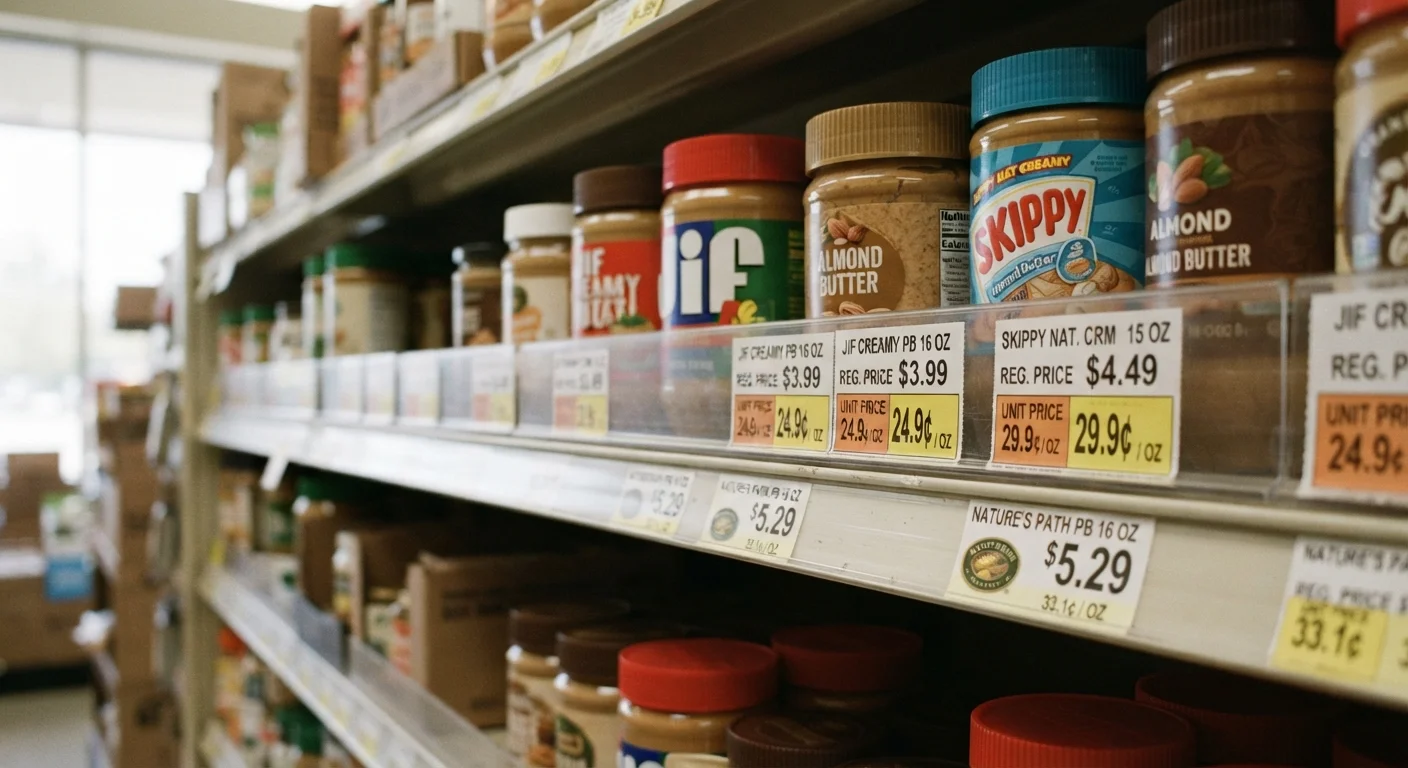
On most U.S. grocery and mass-market retail shelves, the unit price appears on the same tag as the total price - usually in smaller print, often in one corner. It's easy to miss, which is why many shoppers scan for the large number (total price) and move on.
The label typically shows: the total price, the brand and item name, the unit price (e.g., $0.37/oz), and the unit of measure used. That last piece is important: only compare unit prices using the same unit. A price per sheet of paper towel cannot be meaningfully compared to a price per square foot unless you do the conversion yourself.
Some categories use less intuitive units. Diapers are priced per diaper. Contact lens solution is priced per fluid ounce. Protein powder is sometimes priced per gram of protein rather than per ounce of product - a more useful measure for that category. Pay attention to what the unit actually is before drawing conclusions.
Use Your Phone When Labels Are Hard to Read
If shelf tags are small, faded, or placed awkwardly, most grocery store apps and general barcode-scanning apps will display the unit price when you scan a product. This is especially useful when comparing items on different shelves or in different parts of the store.
When Bigger Isn't Better (and Other Surprises)
The conventional wisdom - buy the largest size for the best per-unit value - is wrong often enough to be worth questioning every time. Here are the situations where unit pricing most commonly upends assumptions:
- Store-brand vs. name-brand: A store-brand product in a smaller size frequently has a lower unit price than the name-brand in its largest size. The brand premium can erase the bulk discount entirely.
- Sale items vs. everyday alternatives: A 20% discount on a higher-priced item may still leave it more expensive per ounce than the non-sale alternative next to it.
- Warehouse club quantities: Bulk stores often have strong unit pricing, but only if you'll use what you buy. Spoilage or waste flips the equation. This connects to the broader concept of total cost of ownership - the actual cost of a purchase includes what you don't use.
- Multipack bundles: These are a common spending trap. Bundled items sometimes carry a per-unit premium over buying the same item individually on sale.
Applying unit pricing consistently across your grocery and household shopping is one of the more concrete steps you can take toward the goals outlined in building a workable monthly budget.
Using Unit Price Beyond the Grocery Aisle
Unit pricing is most familiar in food and household goods, but the underlying logic applies wherever you're comparing similar products in different quantities or configurations.
In personal care - shampoo, body wash, skincare - unit pricing by fluid ounce is straightforward. In cleaning products, it helps distinguish concentrated formulas from ready-to-use ones (though you need to account for dilution ratios). In electronics accessories like batteries or cables sold in multipacks, per-unit price is the only sensible comparison point.
For online shopping, many platforms display unit pricing, but consistency varies. When it's not shown, the calculation is simple: divide the price by the quantity or weight. A $12.99 bag of coffee that weighs 12 oz costs $1.08/oz. A $17.49 bag at 18 oz costs $0.97/oz. The larger bag costs more in total but less per cup - or it might still be the wrong choice if you won't finish it before it goes stale.
The habit of checking unit price doesn't require a calculator or a lot of time. Once it becomes second nature at the shelf, it's one of the lowest-effort ways to make more consistent, value-based decisions on everyday purchases.
Unit Pricing Laws Vary by State
Not every U.S. retailer is legally required to display unit prices. Requirements depend on your state and sometimes on the size of the store. If a unit price isn't shown, you can calculate it yourself: divide the total price by the weight or count listed on the package. The math is simple and takes only a few seconds.