
Set Your Budget Before You Shop
The sticker price is only one part of what a car actually costs. Before you visit a lot or browse listings, calculate what you can genuinely afford each month - then work backward to a vehicle price.
Your monthly ownership cost has four components: the loan or lease payment, insurance, fuel, and maintenance. Underestimating any one of them is one of the most common first-time buyer mistakes. If you haven't built a household budget yet, this ground-up budgeting walkthrough can help you map your income and expenses before you commit to a car payment.
A practical approach is to decide on a comfortable monthly total for all car-related costs, then work with that ceiling - not the monthly payment the dealer quotes you in isolation. A longer loan term lowers the monthly payment but increases total interest paid; keep that trade-off in mind.
Build in a Buffer for Hidden Costs
First-time buyers often forget to account for sales tax, title and registration fees, and the first insurance payment - all due at or near purchase. These can add several hundred to over a thousand dollars to your day-one costs. Factor them into your savings target before you finalize a budget.
Understanding Your Financing Options
Unless you're paying cash, you'll borrow money to buy the car. Two main paths exist: a loan through a bank, credit union, or online lender, or financing arranged through the dealership.
Getting pre-approved before you shop is a practical advantage. It tells you your interest rate and maximum loan amount ahead of time, so you can evaluate dealer financing as a comparison rather than an unknown. Credit unions often offer competitive rates for members, and many banks offer pre-approval online.
Key terms to understand:
- APR (Annual Percentage Rate): The true annual cost of borrowing, including fees. Lower is better.
- Loan term: How many months you'll make payments. Longer terms mean lower monthly payments but more total interest.
- Down payment: The amount you pay upfront. A larger down payment reduces how much you borrow and lowers monthly costs.
APR (Annual Percentage Rate)
The yearly cost of borrowing money expressed as a percentage, including interest and certain fees. A lower APR means you pay less over the life of the loan.
Down payment
The portion of the vehicle's purchase price you pay in cash upfront. A larger down payment reduces the loan amount and typically lowers your monthly payment.
Vehicle title
The official government document that names the legal owner of a vehicle. When a loan is involved, the lender typically holds the title until the debt is paid off.
Liability insurance
A type of auto insurance that pays for damage or injuries you cause to other people or their property in an accident. Most states require at least a minimum amount.
VIN (Vehicle Identification Number)
A unique 17-character code assigned to every vehicle at manufacture. It can be used to look up the vehicle's history, including past accidents and ownership records.
Pre-approval
A lender's conditional offer to loan you a specific amount at a defined interest rate before you've chosen a vehicle. It gives you a concrete budget and a baseline to compare dealer financing against.
Evaluating and Choosing a Vehicle
Once your budget is set and financing is lined up, you can shop with clarity. The core question isn't which car you like most - it's which car fits your life and your finances reliably.
For used vehicles, a vehicle history report (available from services that use the VIN, or Vehicle Identification Number) can surface past accidents, title issues, or odometer discrepancies. More importantly, pay for an independent pre-purchase inspection by a mechanic you choose - not one affiliated with the seller. An hour of a mechanic's time can identify hidden problems worth far more than the inspection fee.
For new vehicles, the manufacturer's warranty covers defects for a defined period. Read the warranty terms carefully - powertrain and bumper-to-bumper coverage are typically different durations.
Consider total cost of ownership: fuel economy, insurance cost for that specific model (insurers price models differently), and typical repair costs all vary significantly between vehicles.
Don't Skip the Independent Inspection
A seller's assurance that a car is in good shape is not a substitute for a professional inspection. An independent mechanic has no financial stake in the sale and can identify mechanical issues, rust, or safety concerns that are invisible to an untrained eye. If a private seller refuses to allow an inspection, treat that as a significant red flag.
Paperwork, Title, and Registration
Closing the deal generates a stack of documents. Understanding what each one does prevents surprises later.
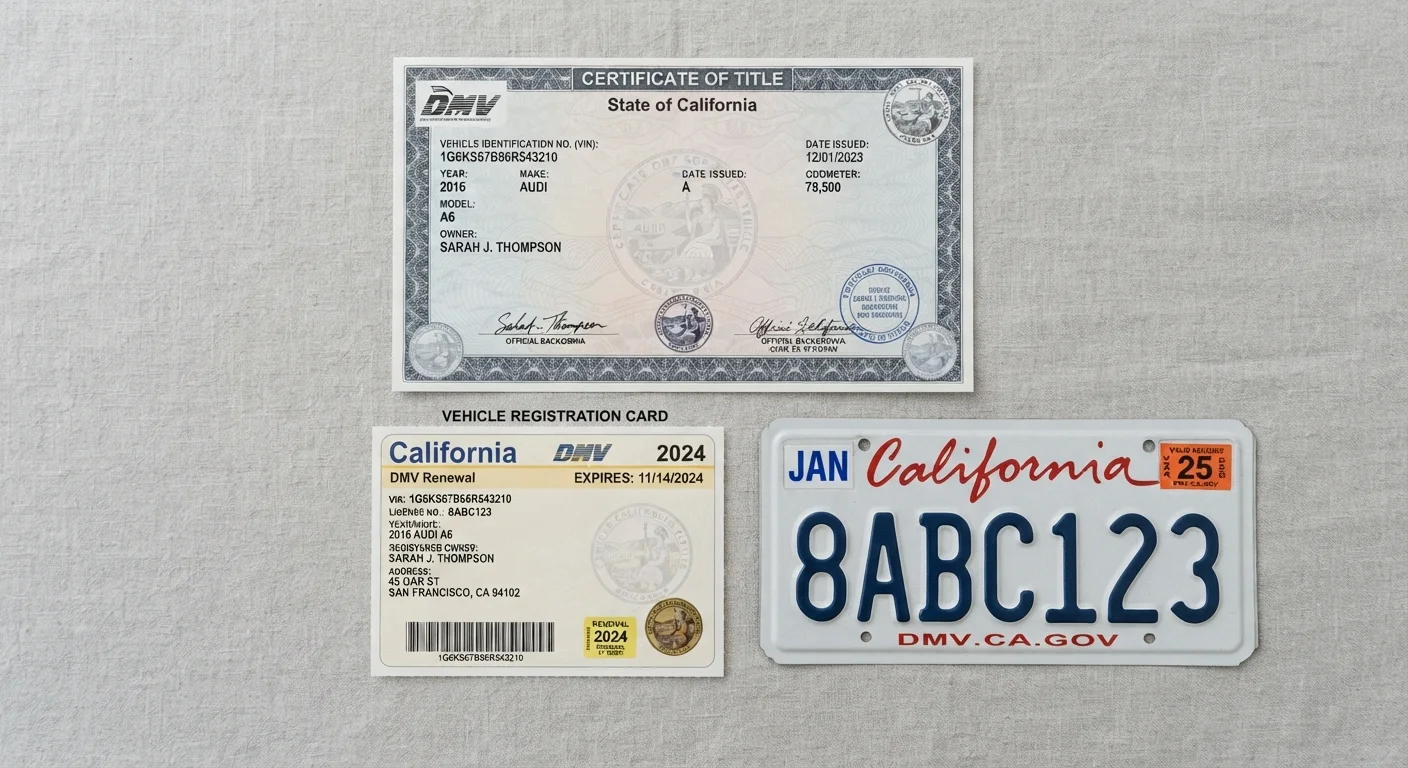
The title is the legal proof of ownership. When you buy a car with a loan, the lender typically holds the title until you pay off the debt. For a private-party sale, transferring the title correctly requires specific signatures and, in many states, a notary or DMV visit. Skipping steps here creates ownership disputes later.
The registration is your state's permit to drive the vehicle on public roads. It must be renewed - usually annually - and your plates are tied to it. For a detailed breakdown of what each document means, see car title, registration, and license plates explained.
At a dealership, the finance office will walk you through the purchase agreement, extended warranty offers, and add-ons. You are not required to purchase add-ons to complete a sale - take time to read what you're signing.
Getting Insured Before You Drive
Insurance is not optional - it's legally required in nearly every state, and you need it active before you drive the car anywhere. Contact insurers for quotes before your purchase date so coverage can begin the day you take possession.
At minimum, most states require liability insurance, which covers damage or injury you cause to others. If you have a loan, the lender will also require collision and comprehensive coverage to protect their financial interest in the vehicle.
Coverage types, deductibles, and premiums vary widely. If you're new to reading insurance documents, this plain-language guide to insurance terminology walks through the vocabulary you'll encounter so you can compare policies meaningfully.
The policy you need depends on your state, your lender's requirements, your vehicle's value, and your personal financial situation. This is general guidance - a licensed insurance agent can help you determine the right coverage for your circumstances.
What Comes After the Lot
Driving away is just the beginning. Ongoing ownership means staying on top of routine maintenance and understanding your vehicle well enough to catch problems early.
Your owner's manual is the most underused resource in most glove boxes. It lists the manufacturer's recommended service intervals for oil changes, tire rotations, fluid checks, and more. Following this schedule - rather than ignoring it until something breaks - is the single most cost-effective thing you can do as an owner.
For a full introduction to what regular upkeep involves, the fundamentals of car ownership for first-time drivers covers the warning signs and maintenance habits that prevent expensive surprises. The car maintenance hub is also a useful ongoing reference as questions come up.
If you're planning a longer drive soon after purchase, run through a basic vehicle check first - this pre-road-trip mechanical walkthrough covers tires, fluids, lights, and emergency supplies.
This article provides general educational information about car buying and ownership. It is not financial, legal, or insurance advice. Consult a licensed professional for guidance specific to your situation and location.