
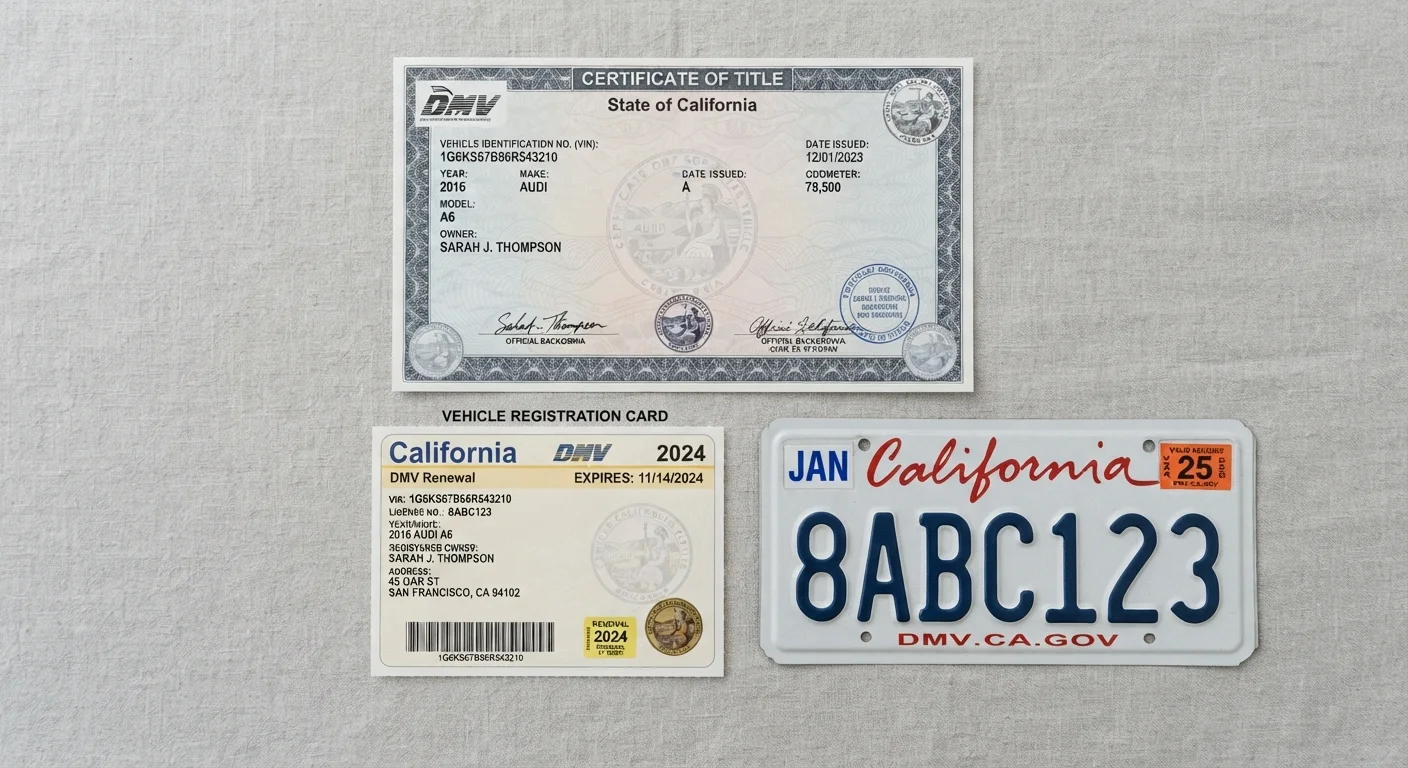
The Big Picture: Three Different Things, One Vehicle
New car owners often treat title, registration, and license plates as interchangeable - a blur of paperwork and fees that comes with buying a vehicle. They're not the same thing. Each one serves a distinct legal purpose, is issued by a different authority, and has real consequences if it's missing or incorrect.
| What a title proves | Legal ownership of the vehicle |
| Who issues titles | State DMV or equivalent agency |
| What registration authorizes | Legal operation on public roads |
| Typical registration cycle | Annual or biennial, varies by state |
| Where to keep registration | In the vehicle at all times |
| Where to keep your title | Secured at home or with lender |
Think of it this way: the title proves who owns the car. The registration gives you permission to drive it on public roads. The plates are how law enforcement and other agencies identify it while it's moving. All three matter, and all three can create headaches if they fall out of order.
For a fuller look at the entire ownership lifecycle - from purchase to eventual resale - see this comprehensive ownership guide.
The Title: Legal Proof of Ownership
A certificate of title is a legal document issued by your state's Department of Motor Vehicles (or equivalent agency) that establishes who owns a vehicle. When you buy a car outright, the title is issued in your name. When you finance, the lender is typically listed as a lienholder - meaning they have a legal claim on the vehicle until the loan is paid off.
The title includes the Vehicle Identification Number (VIN), year, make, model, and owner information. It is not something you carry in your car - it's a document you store safely at home (or with your lender).
Title problems are among the most serious issues a car buyer can face. A salvage title, for instance, means the vehicle was previously declared a total loss by an insurer. A lien that wasn't properly released can block a sale entirely. Before purchasing any used vehicle, checking the title status through your state DMV or a vehicle history report is a sound precaution.
If you're buying or selling, the paperwork involved is more involved than most people expect. Transferring a car title covers what both parties need to do to complete a clean transfer.
Certificate of Title
A state-issued legal document that identifies the rightful owner of a vehicle. It includes the VIN, make, model, and any lien information.
Lienholder
A lender or financial institution with a legal claim on a vehicle because it financed the purchase. The lien is released when the loan is fully repaid.
Vehicle Registration
An annual or biennial government authorization allowing a specific vehicle to be legally operated on public roads. It does not establish ownership.
Salvage Title
A title designation indicating the vehicle was previously declared a total loss by an insurance company due to damage, flood, or theft recovery. It affects resale value and insurability.
VIN (Vehicle Identification Number)
A unique 17-character code assigned to every motor vehicle, used to identify it across title, registration, and insurance records.
Emissions Test
A state-mandated inspection to verify a vehicle's exhaust output meets environmental standards. Many states require passing results before registration renewal.
Registration and Plates: Permission to Drive
Vehicle registration is an annual (or biennial, depending on the state) authorization from your state allowing you to operate your car on public roads. It doesn't prove ownership - it proves the vehicle is legally cleared to be driven. Registration is tied to the car, not the person, though the registered owner must match the title holder in most states.
Registration fees vary significantly by state and are often calculated based on vehicle weight, value, or age. Many states also use registration renewal as a checkpoint for emissions compliance - if your car fails an emissions test, you may not be able to renew until it's repaired.
Your registration card (or a digital version, accepted in some states) should be kept in the vehicle. Law enforcement may ask for it during a traffic stop along with your driver's license and proof of insurance.
License plates are the physical identifier attached to your vehicle. They're assigned at registration and must be displayed in the locations required by your state - typically front and rear, though some states only require a rear plate. The small sticker or tab on your plate shows the current registration expiration year (and sometimes month).
Plates can be transferred to another vehicle in many states when you sell or trade, or surrendered if you're canceling insurance or taking the car off the road. Some specialty and vanity plates carry additional fees.
If you're going through this for the first time, this first-car roadmap walks through the full process from search to registration in plain terms.
Rules Vary Significantly by State
Title, registration, and plate requirements differ from state to state - including fees, renewal periods, front-plate requirements, and emissions testing rules. Always check with your state's DMV directly for accurate, current requirements. If you've recently moved, you typically have a limited window (often 30-90 days) to transfer your title and registration to your new state.