How Sound Quality Actually Differs
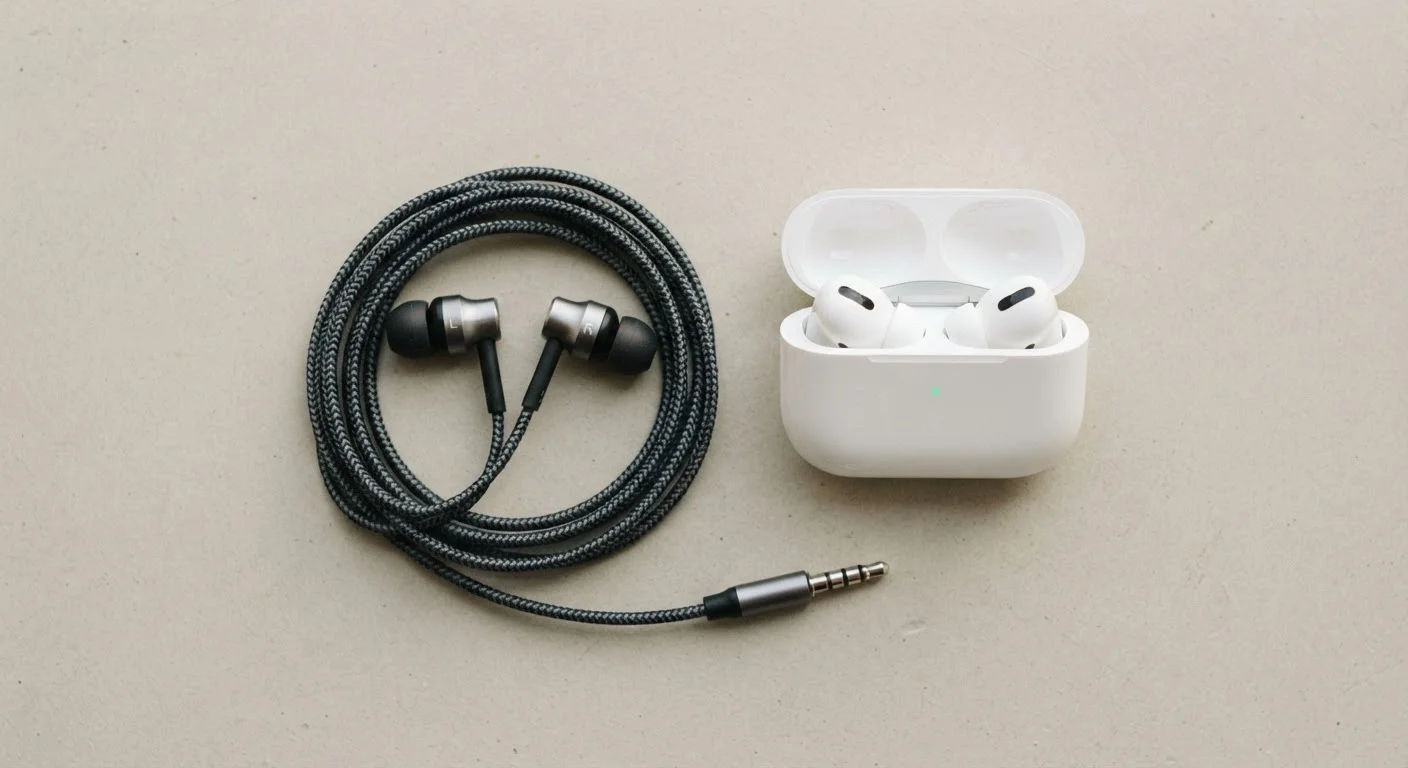
The most common claim about wired earbuds is that they sound better - and in a technical sense, there's a basis for it. A wired connection carries an analog audio signal directly from the source to your ear, with no intermediate conversion step. Wireless earbuds, by contrast, receive a digital Bluetooth signal that has been encoded, transmitted, and then decoded in the earbud itself. That encoding process uses audio codecs - standards like SBC, AAC, aptX, and LDAC - each of which handles compression differently.
In practice, the gap is narrower than audiophile forums suggest for most listeners. Entry-level wired earbuds don't automatically outperform mid-range wireless ones; driver quality, earbud fit, and ear canal seal have more impact on perceived sound than the wired-versus-wireless distinction alone. Higher-end Bluetooth codecs like LDAC transmit enough data to satisfy all but the most trained ears in casual settings. The meaningful sound quality advantage of wired connections is most audible during critical listening - evaluating fine musical detail, comparing mixes, or monitoring recordings.
| Criterion | Wired Earbuds | Wireless Earbuds |
|---|---|---|
| Audio Signal Path | Direct analog, no compression | Bluetooth codec, compressed digital |
| Latency | Under 5 ms (negligible) | 40-200+ ms depending on codec |
| Battery Required | No - powered by source device | Yes - 5-8 hrs per charge typical |
| Cable Management | Cable always present | Cable-free |
| Device Compatibility | Requires 3.5mm jack or adapter | Bluetooth - works with most modern devices |
| Extra Features | Limited; audio-focused | ANC, touch controls, ambient mode common |
| Durability Risk | Cable wear over time | Battery degrades over charge cycles |
Latency: When Milliseconds Matter
Latency - the delay between an audio signal being sent and you hearing it - is where wired earbuds hold a clear, objective advantage. Wired connections introduce negligible delay, typically under 5 milliseconds. Bluetooth transmission adds latency that varies by codec and device pairing, commonly ranging from around 40 milliseconds at the low end with aptX Low Latency to over 200 milliseconds with standard SBC connections.
For everyday music listening, that delay is imperceptible. But it becomes noticeable - and genuinely disruptive - in two scenarios: watching video, where audio can drift visibly out of sync with on-screen lips, and gaming, where sound cues tied to in-game events arrive late. Many wireless earbuds now include a dedicated "game mode" or "low latency mode" that reduces delay significantly, though this often comes at a cost to audio quality or battery life. If latency is a regular concern in your use, it's worth checking whether your wireless earbuds offer this mode and whether your device supports a low-latency codec.
~200ms
Typical Bluetooth SBC latency
Standard SBC codec - the default Bluetooth audio standard - commonly introduces 150-200 ms of delay, enough to cause visible lip-sync issues in video.
< 40ms
Low-latency Bluetooth codec delay
Codecs such as aptX Low Latency and proprietary game modes can reduce wireless latency to under 40 ms, approaching near-imperceptible levels for most use cases.
990kbps
LDAC maximum transmission rate
Sony's LDAC codec transmits up to 990 kbps of audio data, significantly closer to lossless audio than standard Bluetooth codecs, though device support varies.
Everyday Trade-Offs: Convenience, Compatibility, and Battery Life
Beyond sound and latency, the daily experience of using each type diverges in practical ways. Wireless earbuds are genuinely more convenient for movement - no cable to manage, snag, or tangle. This matters most for commuters, gym-goers, and anyone who listens while doing something with their hands. Many current models also offer useful features like automatic ear detection, ambient sound modes, and touch controls that wired earbuds rarely match.
Compatibility has shifted in wireless earbuds' favor as the headphone jack has disappeared from many flagship smartphones and thin laptops. Wired earbuds often require an adapter to connect to USB-C or Lightning ports, adding a small but real point of friction. That said, wired earbuds remain universally compatible with any device that retains a 3.5mm jack, need no pairing, and work immediately on connection.
Battery life is the wireless earbud's Achilles' heel. Most wireless earbuds offer five to eight hours of playback per charge, with charging cases extending total use. But a forgotten charge the night before a long flight is a real inconvenience. Wired earbuds draw from the source device and simply work as long as your phone or laptop does. For readers weighing similar reliability questions in other contexts, the wired vs. wireless home security camera trade-offs follow a parallel logic of dependability versus flexibility.
There's also a broader pattern worth recognizing: wireless technology almost always involves some exchange of control or reliability for convenience, a trade-off explored in detail in our look at convenience and privacy in everyday tech.
Codec Support Varies by Device
Not all Bluetooth codecs work on all devices. A wireless earbud that supports aptX or LDAC will only use those codecs if the connected phone or computer also supports them - otherwise both devices fall back to the universally supported SBC standard. Before assuming you'll get a particular codec's benefits, check both the earbud and your source device's specifications.