Why Drivers and Vulnerable Road Users Keep Misreading Each Other
Most drivers don't set out to endanger anyone. But on roads designed primarily around cars, it's easy to develop blind spots - literal and figurative - about cyclists and pedestrians. The speed and mass advantage a vehicle has makes every miscommunication costly in a way it simply isn't between two cars of similar weight.
Cyclists travel faster than most drivers expect, often 12-20 mph, which compresses reaction time significantly. Pedestrians, meanwhile, may assume they've made eye contact with a driver who hasn't actually registered them. These aren't failures of character - they're predictable gaps in how each party reads shared space. Closing those gaps starts with understanding the rules and the physics, not just who had the right-of-way after the fact.
For a broader look at how road behavior contributes to serious crashes, see U.S. road safety patterns and risk factors.
7,522
Pedestrian fatalities on U.S. roads
According to the National Highway Traffic Safety Administration (NHTSA), approximately 7,522 pedestrians were killed in traffic crashes in 2022, the highest number in four decades.
~1,000
Cyclists killed annually in the U.S.
NHTSA data consistently shows roughly 800-1,000 cyclists are killed in motor vehicle crashes each year, with many more thousands injured.
76%
Pedestrian deaths occurring outside daylight hours
NHTSA research indicates that a significant majority of pedestrian fatalities occur in dark conditions, highlighting the risk of limited visibility for both parties.
Core Practices for Driving Safely Around Cyclists and Pedestrians
The following practices reflect established road safety guidance and are applicable across most U.S. driving environments - urban, suburban, and rural. Conditions vary, and local laws may differ, so always follow posted rules and signage in your area.
Give cyclists a full three feet of passing clearance - more when traveling at speed.
Most states legally require at least three feet of space when passing a cyclist, but at highway-adjacent speeds, that margin becomes dangerously tight. A gust of wind, a pothole swerve, or a door opening can push a cyclist into your path with no warning. More space costs you almost nothing in time.
Use the Dutch reach when exiting a parked vehicle.
Dooring - opening your car door into a passing cyclist - causes serious injuries and is legally the driver's or passenger's fault in most jurisdictions. The Dutch reach involves opening the door with your far hand, which physically turns your body toward the mirror and the road, making an approaching cyclist much harder to miss.
Yield to pedestrians at all crosswalks - marked and unmarked.
In the U.S., pedestrians generally have the right-of-way in marked crosswalks and at intersections even where no lines are painted. Many drivers don't realize unmarked crosswalks exist at every intersection where sidewalks meet. Failing to yield is both illegal and a leading cause of pedestrian fatalities.
Treat cyclists as vehicle traffic when they occupy a travel lane.
Cyclists are legally allowed to occupy a full travel lane in most states when no bike lane is present or when the shoulder is unsafe. Tailgating, honking, or passing too closely in this situation is both aggressive and dangerous. Following at an appropriate distance and passing safely when safe to do so is the correct response.
Reduce speed proactively in pedestrian-heavy zones, regardless of the posted limit.
Posted speed limits represent a legal maximum under normal conditions, not a target. In school zones, near parks, at bus stops, or wherever foot traffic is heavy, driving well under the limit gives you the stopping distance to react to a child running into the street or a pedestrian stepping from between parked cars. Speed and crash severity are directly linked - even a 5 mph reduction matters significantly.
Make your intentions clear and early with signals and eye contact.
Cyclists and pedestrians rely heavily on predicting driver behavior. A late or absent turn signal, or ambiguous positioning, forces them to guess - and guessing creates risk. Signaling well in advance and, where possible, making deliberate eye contact with pedestrians before yielding confirms that you've seen them and are stopping.
Intersections Are Where Most Harm Happens
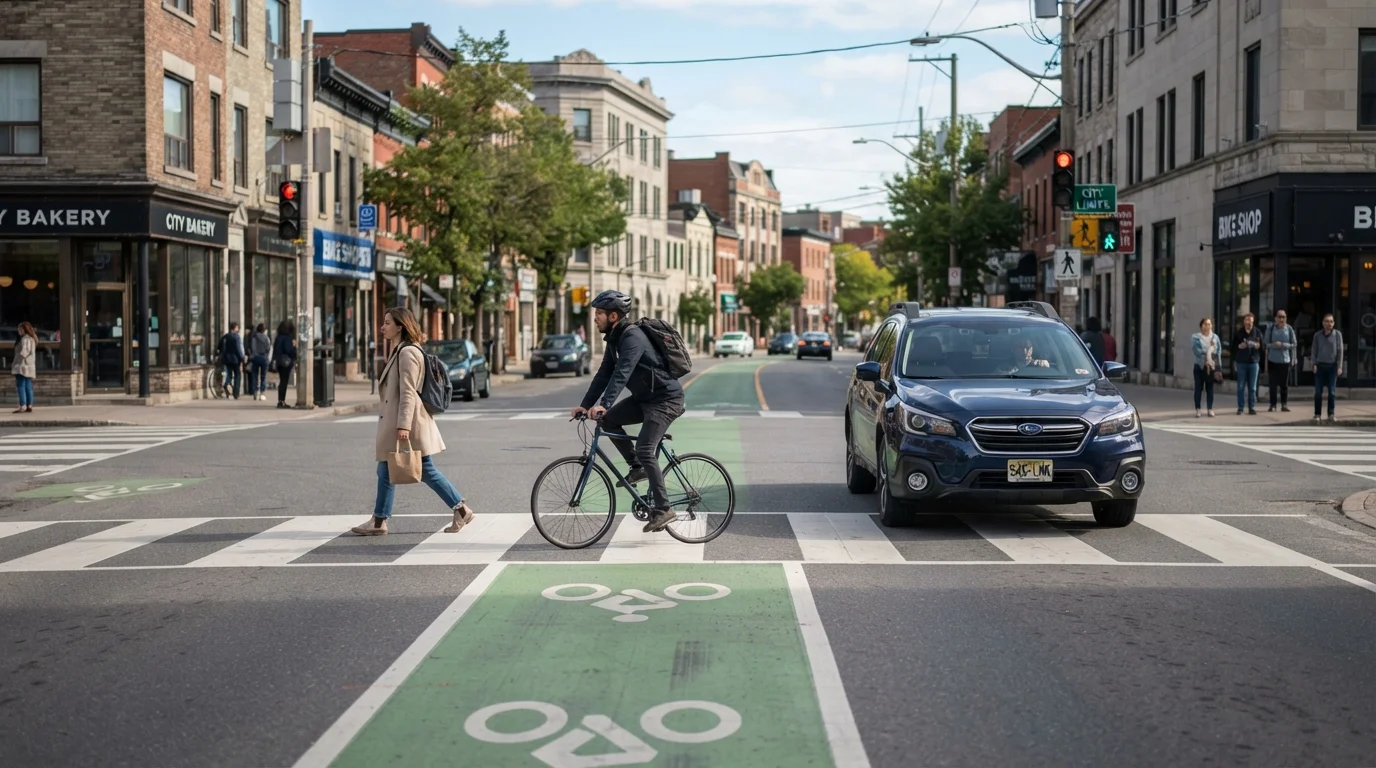
The turn is where drivers most frequently collide with cyclists and pedestrians. A right turn on red, a quick left across oncoming traffic, a rolling stop at a crosswalk - each of these compressed moments demands more attention than drivers typically give them. The cyclist approaching on the right is often invisible until the last second if the driver is focused on the gap in vehicle traffic.
A useful habit: before completing any turn, pause deliberately and look for non-vehicle traffic independently of your vehicle scan. Treat it as a separate check, not a merged one. This is especially critical at multi-lane crossings, where a stopped car in one lane can block your view of a pedestrian who is legally in the crosswalk.
Intersection crash patterns and driver behavior covers the specific habits - including yours - that make these moments so consistently dangerous.
The 'Two-Stage' Turn Check
Before completing any turn - left or right - train yourself to run two separate visual scans: one for vehicle traffic, then one specifically for cyclists and pedestrians. Because these road users are smaller and faster than you expect, a merged scan often misses them. Slowing your turn slightly gives both scans time to register what's actually there.
Quick Actions You Can Build In Starting Today
Adjusting your habits around vulnerable road users doesn't require a course or major lifestyle change. Several small, deliberate behaviors can meaningfully reduce your risk of causing harm - and most take only seconds to implement.
If you want to build a more comprehensive safety mindset, defensive driving principles and mindset outlines how anticipation and attitude work together on any road.