
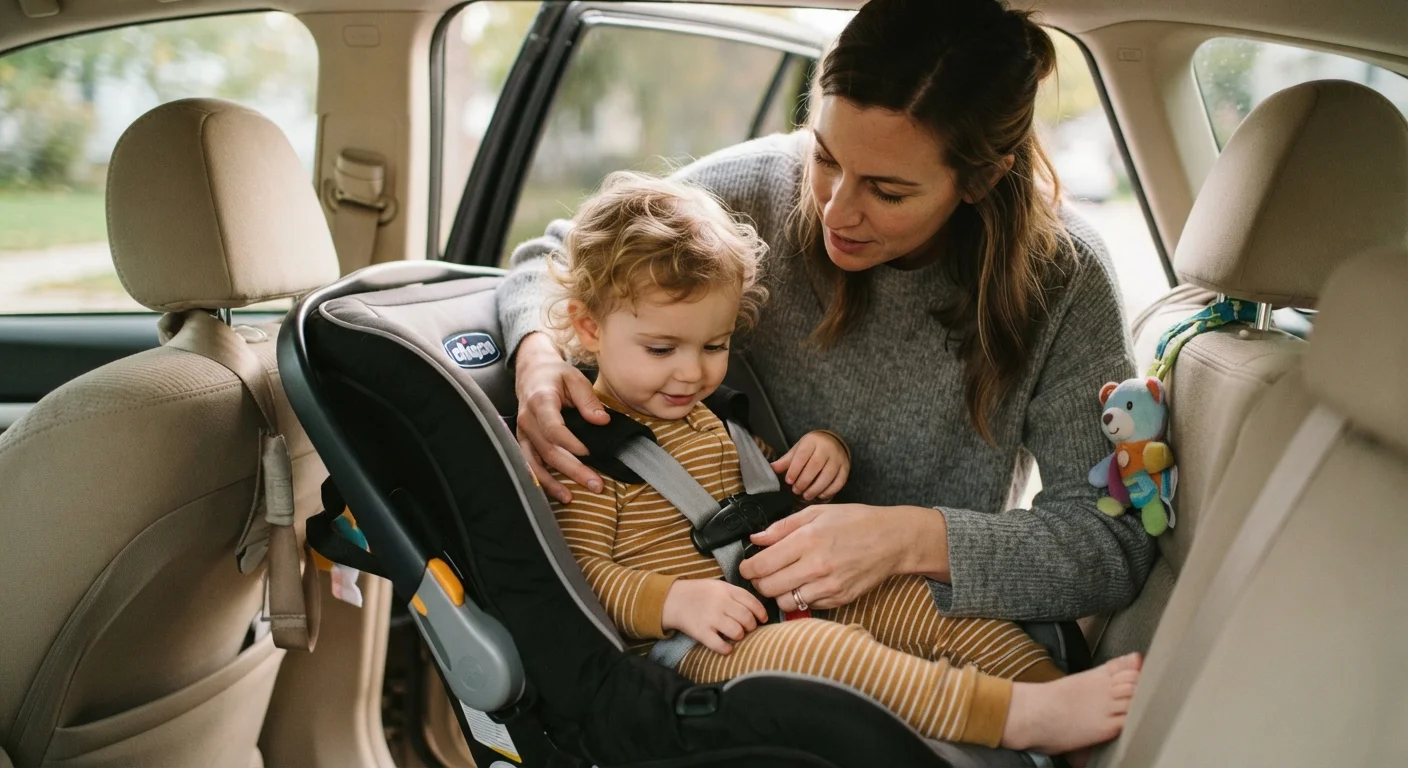
Why Car Seat Stages Exist
Car seat stages aren't arbitrary rules. They're based on decades of crash-test research and biomechanical data showing how a child's developing body - particularly the spine, neck, and internal organs - responds to collision forces at different sizes and ages.
A newborn's head is proportionally very large and the neck muscles are not developed enough to withstand forward deceleration forces in a crash. An adult seat belt, designed for a body at least 4 feet 9 inches tall with adult bone density, does not restrain a small child safely. Each stage is an engineering solution matched to a developmental window.
Understanding the rationale behind each stage helps caregivers make better decisions - including the most important one: staying in each stage until the child has genuinely outgrown it, not just because a birthday has passed.
State Laws vs. Current Safety Guidance
Every U.S. state has child restraint laws, but they set minimum legal requirements - not optimal safety standards. In many states, the law permits a child to move to a booster earlier than current pediatric safety guidance recommends. Following your state's law keeps you legal; following AAP and NHTSA guidance gives your child the best protection available. When the two differ, current safety guidance is the higher bar.
Stage 1: Rear-Facing Car Seats
Rear-facing is the starting point for all children, from birth through infancy and into the toddler years. In this position, crash forces are distributed across the back of the seat shell, which spreads the load across the child's entire back, head, and neck rather than concentrating it on any single point.
There are two main types used in this stage: infant-only seats (with lower weight limits, typically up to 22-35 lbs depending on the model) and convertible seats that can be used rear-facing for larger weight limits before being turned forward-facing.
The key rule: keep a child rear-facing until they reach the maximum weight or height allowed by that specific seat's manufacturer. Many children can remain rear-facing well past age two. State laws vary, but current safety guidance consistently recommends rear-facing for as long as the seat allows.
Check Your Seat's Manual, Not Just the Box
Weight and height limits vary significantly between car seat models, even within the same stage. Always consult the specific manual that came with your seat - and keep it in the vehicle - rather than relying on general age-based guidelines. If you've lost the manual, most manufacturers make them available as free downloads on their websites.
Stage 2: Forward-Facing Seats with a Harness
Once a child exceeds their rear-facing seat's limits, they move to a forward-facing seat with a five-point harness. The harness distributes crash forces across the strongest parts of the body - shoulders, hips, and chest - while the seat itself absorbs energy.
Forward-facing convertible seats and combination seats typically accommodate children up to 40-65 lbs in harness mode, depending on the model. The harness should fit snugly: the chest clip sits at armpit level, straps lie flat with no slack, and the pinch test at the shoulder shows no excess webbing.
A common mistake is moving to a booster seat too early because a child looks big enough. The harness provides substantially more protection than a seat belt alone for children who still fit within the limits. Stay in the harness stage until the manufacturer's limits are genuinely reached.
~46%
Car seats estimated to be misused
NHTSA and child passenger safety researchers have consistently found that a substantial proportion of car seats observed in studies are misused in some way, including incorrect installation or harness fit.
71%
Reduction in crash fatality risk for infants in car seats
According to NHTSA, car seats reduce the risk of death by approximately 71% for infants and 54% for toddlers ages 1-4 in passenger vehicle crashes, compared to seat belt use alone.
4 ft 9 in
Typical height for adult seat belt fit
The AAP and NHTSA both indicate that most children reach proper seat belt fit - without a booster - at around 4 feet 9 inches tall, generally between ages 8 and 12.
Stage 3: Booster Seats
Booster seats serve one primary purpose: positioning the vehicle's seat belt so it crosses the child's body correctly. A lap-and-shoulder belt on a child who is too small cuts across the abdomen and neck rather than the hips and chest - exactly where it should not sit in a crash.
There are two types of boosters: high-back boosters (which provide head and neck support and are recommended for vehicles without headrests) and backless boosters (suitable for vehicles with adequate headrests). Both work by raising the child so the belt fits properly.
Children should use a booster until the seat belt fits without one - typically when the child is about 4 feet 9 inches tall, usually somewhere between ages 8 and 12. The belt-fit test: lap belt lies across the upper thighs (not the stomach), shoulder belt crosses the chest and shoulder (not the neck), and the child can sit with their back against the seat for the entire trip.
If you're navigating the broader responsibilities of vehicle ownership alongside child safety, our guide for first-time car owners covers the essentials from insurance to registration.
Installation, Registration, and Common Mistakes
Even the right seat for the right stage provides less protection if it's installed incorrectly. Studies have consistently found that a significant proportion of car seats on the road are misused in some way - incorrect angle, loose installation, improperly routed belt, or misused harness.
Key installation principles that apply across stages:
- Use the correct attachment system: LATCH (Lower Anchors and Tethers for Children) or the vehicle seat belt - but not both simultaneously unless the manufacturer explicitly permits it.
- Check the recline angle for rear-facing seats using the built-in indicator.
- Always use the top tether for forward-facing seats - it significantly reduces head movement in a crash.
- Register the seat with the manufacturer so you receive recall notices.
- Never use a secondhand seat if you don't know its full history - seats involved in moderate or severe crashes should be replaced.
Free car seat inspection events, staffed by certified Child Passenger Safety Technicians (CPSTs), are available across the country. NHTSA's website provides a locator tool. For drivers who want to build a solid foundation of vehicle ownership habits - including how to maintain and troubleshoot a car - see our car ownership fundamentals guide.