
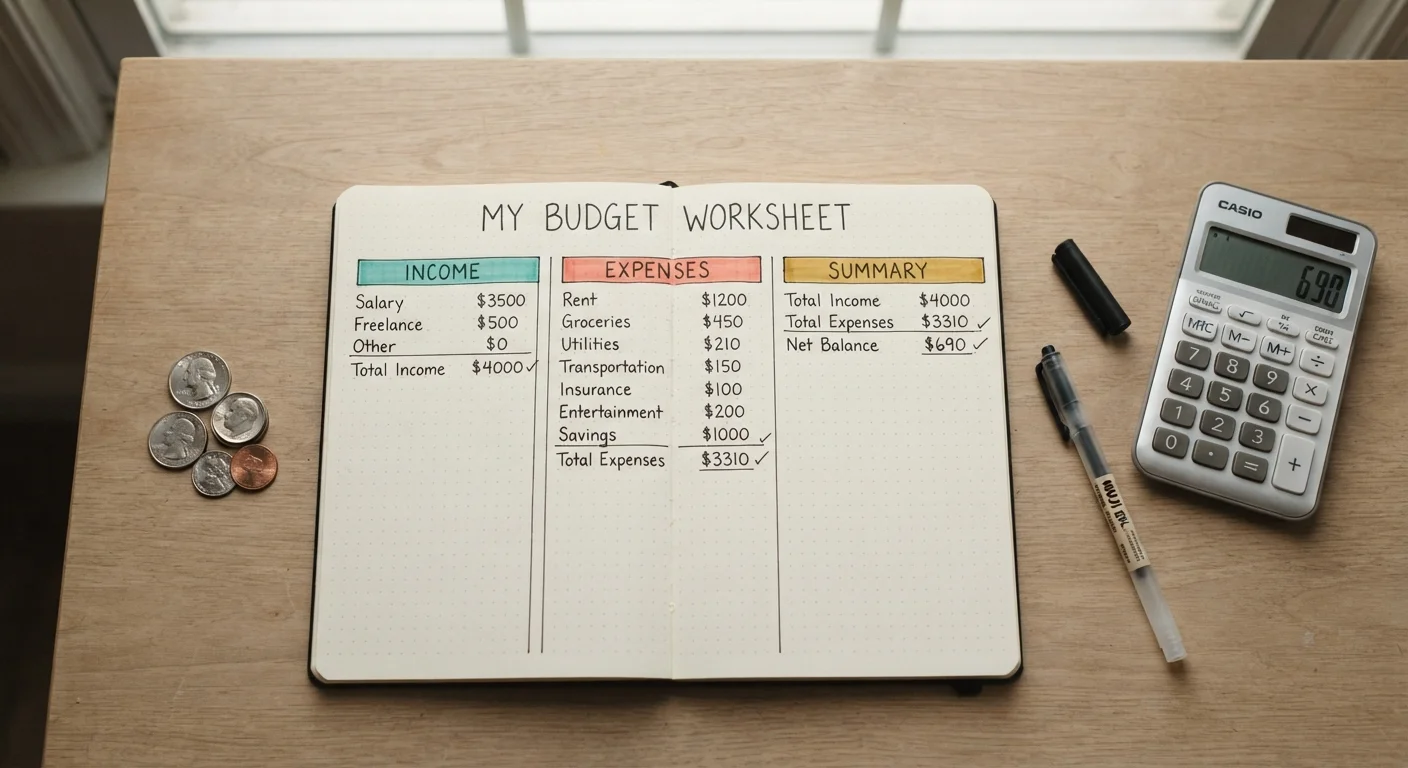
What the 50/30/20 Rule Actually Says
The 50/30/20 rule is a percentage-based budgeting guideline popularized by U.S. Senator Elizabeth Warren and her daughter Amelia Warren Tyagi in their 2005 book All Your Worth. The framework divides your after-tax income - what hits your bank account - into three broad categories:
- 50% for needs: Rent or mortgage, utilities, groceries, minimum debt payments, insurance, and transportation to work.
- 30% for wants: Dining out, entertainment, subscriptions, travel, and anything beyond bare necessities.
- 20% for savings and debt repayment: Emergency funds, retirement contributions, and paying down debt above the minimums.
The appeal is clarity. You don't need a spreadsheet tracking 30 line items - just three numbers. For someone who has never budgeted before, that simplicity can be transformative. See how intentional spending habits reinforce this kind of structure in our guide to smarter shopping habits.
Simple enough to start using immediately
Three categories replace complex spreadsheets, lowering the barrier to entry for first-time budgeters. Most people can assess their spending against three buckets within an hour.
Builds saving as a non-negotiable habit
By giving savings its own 20% allocation rather than treating it as whatever is left over, the framework embeds saving into the structure of monthly spending.
Flexible enough to adjust as life changes
The percentages aren't locked in - households can shift the ratios as income grows, debt decreases, or financial goals evolve over time.
Encourages distinction between needs and wants
Many people conflate habitual spending with essential spending. Separating the two categories forces a useful examination of what is truly necessary versus what is chosen.
Works alongside other financial goals
The 20% savings category can accommodate multiple objectives - emergency fund, retirement contributions, and extra debt payments - making it adaptable without requiring a separate framework.
Where the Rule Falls Short
Despite its intuitive appeal, the 50/30/20 framework runs into friction quickly when real-world income and expenses don't cooperate.
Unrealistic for lower-income households
When essential expenses consume the majority of take-home pay, a 20% savings target isn't just difficult - it may be arithmetically impossible without increasing income or dramatically cutting costs.
Housing costs can blow past the 50% ceiling
In high-cost-of-living metro areas, rent or mortgage alone often exceeds 40-50% of a middle-income earner's take-home pay, leaving no room for other essential expenses within the guideline.
Doesn't account for irregular income
Applying fixed percentages to a paycheck that varies month to month creates instability. A bad month can make the entire formula unworkable without a modified approach.
The needs/wants boundary is genuinely blurry
Is a smartphone plan a need or a want? What about a gym membership for someone managing a chronic health condition? The categories seem clear but quickly become subjective in practice.
Ignores high existing debt loads
For someone carrying significant student loan or credit card debt, 20% split between savings and debt repayment may be insufficient to make meaningful progress on either front.
One of the most significant gaps is income level. A household earning $35,000 a year after taxes has roughly $1,458 a month to work with. Allocating 50% - about $729 - to needs leaves very little room for actual housing in most U.S. markets, let alone groceries, car payments, or health insurance. The math simply doesn't hold for lower earners.
Geographic reality compounds the problem. In cities like San Francisco, New York, or Boston, median rent for a one-bedroom apartment can consume 40-50% of a middle-class income on its own - leaving nothing for other needs. This isn't a budgeting failure; it's a structural mismatch between a national guideline and local economic conditions.
People with irregular income face a different challenge entirely. Freelancers, gig workers, and tipped employees can't reliably apply fixed percentages to a paycheck that changes month to month. If that describes your situation, practical strategies for variable income budgeting may offer more useful tools.
What Counts as a "Need" Matters
The 50% needs category is only as useful as the honesty applied to it. Housing, utilities, groceries, basic transportation, insurance premiums, and minimum debt payments are widely accepted as needs. Streaming services, dining out, and gym memberships are generally wants - even if they feel essential. Misclassifying wants as needs inflates the 50% bucket and quietly crowds out savings. Taking time to audit each expense category can reveal surprising flexibility.
Adapting the Framework to Your Reality
The most useful reframe: treat 50/30/20 as a directional guide rather than a strict target. If your needs genuinely consume 60% of your take-home pay, the framework's value isn't in forcing that number down to 50% overnight - it's in revealing the gap and prompting questions about what to do next.
37%
Americans with no emergency savings
A Bankrate survey found approximately 37% of U.S. adults would not be able to cover a $400 emergency expense from savings alone, underscoring the real difficulty of the 20% savings target.
30%+
Income spent on housing by many renters
The U.S. Department of Housing and Urban Development considers households that spend more than 30% of income on housing to be "cost-burdened," a threshold millions of American renters exceed.
Some financial educators suggest modified splits - 60/20/20 or 70/20/10 - for lower-income households, prioritizing stability over aggressive saving. Others recommend reversing the order of operations: set aside savings first, then spend what remains across needs and wants. This "pay yourself first" approach can be especially effective when savings feel perpetually squeezed.
As your income grows and financial stability improves, adjusting the savings percentage upward becomes more achievable. Our realistic investing framework walks through how to begin directing those savings productively, even with modest amounts. For building broader financial resilience, the Saving & Debt hub offers additional actionable guidance.
The rule works best when used as a diagnostic tool - a way to see clearly where your money is actually going and whether those flows align with your priorities. It's a starting point, not a finishing line.
This article is for general informational and educational purposes only and does not constitute personalised financial advice. For guidance specific to your situation, consult a qualified financial professional.