
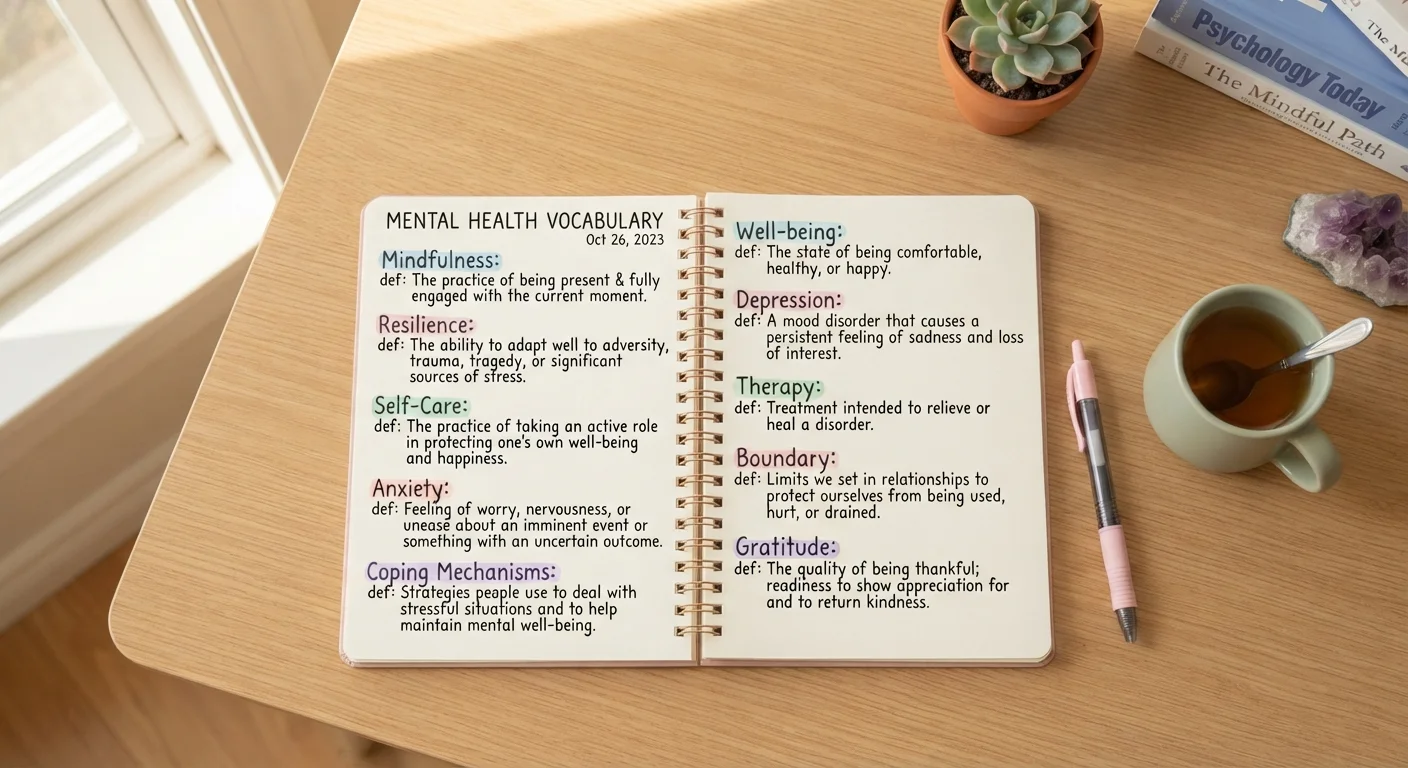
Why Mental Health Vocabulary Matters
Mental health conversations happen everywhere - in doctors' offices, on social media, in workplaces, and at kitchen tables. Yet the terminology can feel intimidating, clinical, or imprecise, leaving people unsure whether what they're reading or hearing actually applies to their experience.
This reference explains the most widely used mental health terms in plain, stigma-free language. It is designed for general information and education only - not as a diagnostic tool or substitute for professional guidance. If you have concerns about your mental health or that of someone you care about, a qualified mental health professional is always the right resource.
For a broader look at how mental wellness fits into everyday American life, see our complete mental wellness overview.
Mental health
A person's overall emotional, psychological, and social well-being. It influences how people think, feel, and act, and affects how they handle stress, relate to others, and make decisions.
Anxiety disorder
A category of conditions marked by excessive, persistent worry or fear that is difficult to control and interferes with daily life. Common types include generalized anxiety disorder, social anxiety disorder, and panic disorder.
Depression
Clinically known as major depressive disorder, depression involves persistent low mood, loss of interest, and changes in sleep, energy, and concentration lasting at least two weeks. It is a medical condition, not a personal failing.
Cognitive distortion
An inaccurate, negatively biased pattern of thinking that tends to reinforce unhelpful emotions. Examples include catastrophizing (expecting the worst) and all-or-nothing thinking (seeing situations as entirely good or entirely bad).
Psychotherapy
A structured, talk-based treatment for mental health conditions conducted by a trained professional. Different approaches - such as CBT, DBT, or psychodynamic therapy - suit different needs and conditions.
Trauma
The lasting emotional and psychological impact of a deeply distressing event or series of events. Trauma responses vary widely between individuals and do not reflect weakness or fault.
PTSD
Post-Traumatic Stress Disorder is a condition that can develop after exposure to a traumatic event. Symptoms may include intrusive memories, avoidance, hypervigilance, and negative changes in mood or thinking.
Psychosis
A state involving a break from shared reality, often including hallucinations or delusions. It is a symptom rather than a standalone diagnosis and can occur in several different conditions.
Resilience
The capacity to adapt and recover in the face of adversity, stress, or trauma. Resilience is not a fixed trait - it can be supported and strengthened over time through relationships, skills, and habits.
Stigma
Negative attitudes, stereotypes, or discrimination directed at people with mental health conditions. Stigma can discourage people from seeking help and is widely recognized as a barrier to mental health care.
Mindfulness
Intentional, nonjudgmental attention to present-moment experience. Mindfulness-based practices are incorporated into several evidence-based therapies and are associated with stress reduction in research settings.
Crisis
In mental health contexts, a crisis is a period of acute distress that overwhelms a person's ability to cope. Crisis resources, including the 988 Suicide and Crisis Lifeline in the U.S., provide immediate support.
Terms You'll Encounter Most Often
The terms below appear frequently in clinical settings, public health materials, and everyday conversation. Understanding what each one actually means - rather than its popular shorthand - helps you ask better questions and make more informed decisions.
| Adults with any mental illness (U.S.) | Approximately 1 in 5 (SAMHSA National Survey on Drug Use and Health) |
| Most common mental health condition | Anxiety disorders (National Institute of Mental Health (NIMH)) |
| Average delay between symptom onset and treatment | 11 years (National Alliance on Mental Illness (NAMI)) |
| U.S. crisis support line | Call or text 988 (988 Suicide and Crisis Lifeline) |
| Evidence-based therapy types | CBT, DBT, EMDR, and others (American Psychological Association) |
Mood and Anxiety
Anxiety disorder refers to a group of conditions - including generalized anxiety disorder, panic disorder, and social anxiety disorder - characterized by persistent, excessive worry or fear that interferes with daily functioning. Feeling nervous before a presentation is normal; an anxiety disorder is more pervasive and harder to control. Our companion piece, things people get wrong about anxiety disorders, explores common misconceptions in detail.
Depression (clinically, major depressive disorder) involves sustained low mood, loss of interest or pleasure, and a range of physical and cognitive changes lasting at least two weeks. It is distinct from ordinary sadness and is one of the most common mental health conditions in the United States.
Thought Patterns and Therapy Language
Cognitive distortions are habitual, inaccurate thought patterns - such as all-or-nothing thinking, catastrophizing, or mind reading - that can maintain or worsen distress. Recognizing them is a core skill in many evidence-based therapies.
CBT (Cognitive Behavioral Therapy) is a structured, evidence-based psychotherapy that examines the relationship between thoughts, feelings, and behaviors. It is one of the most researched therapeutic approaches for conditions including depression, anxiety, and PTSD.
Trauma describes the lasting emotional response to a deeply distressing or threatening event. Not everyone who experiences a difficult event develops a trauma-related disorder; individual response depends on many biological and contextual factors.
Labels Describe Experiences, Not People
Mental health terms are clinical shorthand for patterns of experience - they are not character judgments or permanent identities. A diagnosis can open the door to appropriate support, but no term defines a person's full story. If you encounter a term in a clinical document or conversation that you don't understand, it's always appropriate to ask your provider to explain it in plain language.
Psychosis involves a disconnection from shared reality, which may include hallucinations (perceiving things that aren't present) or delusions (firmly held false beliefs). It is a symptom that can appear in several conditions, not a diagnosis on its own.
This article is for general informational purposes only and does not constitute medical advice. Always consult a qualified mental health or healthcare professional regarding any personal health concerns.