
Why Policy Documents Feel So Difficult
Insurance policies are legal contracts, and they read like it - dense paragraphs, cross-references, and terms that carry meanings different from everyday use. This complexity isn't accidental; precise language protects both the insurer and the policyholder in a dispute. But it also creates a real barrier for anyone trying to understand what they actually purchased.
The good news: virtually every insurance policy in the U.S. follows the same underlying structure. Once you know the five or six standard sections and what each one does, navigating an unfamiliar document becomes significantly easier. For a fuller map of those sections, see the anatomy of an insurance policy. If you're new to insurance terminology more broadly, a first-time buyer's map to insurance language is a helpful starting point before you dive into a document.
What you will need
Tools That Help Before You Start Reading
Having the right resources on hand before you open the document reduces frustration and helps you move through the policy systematically rather than reactively.
Policy Document (PDF or Print)
The primary document you will navigate using the steps in this guide.
Insurance Glossary Reference
Helps decode unfamiliar terms not defined within the policy itself.
Highlighter or Digital Annotation Tool
Used to mark coverage language, exclusions, and conditions for later review.
Licensed Insurance Agent Contact
A professional who can clarify ambiguous language specific to your policy.
Use the Table of Contents as a Roadmap
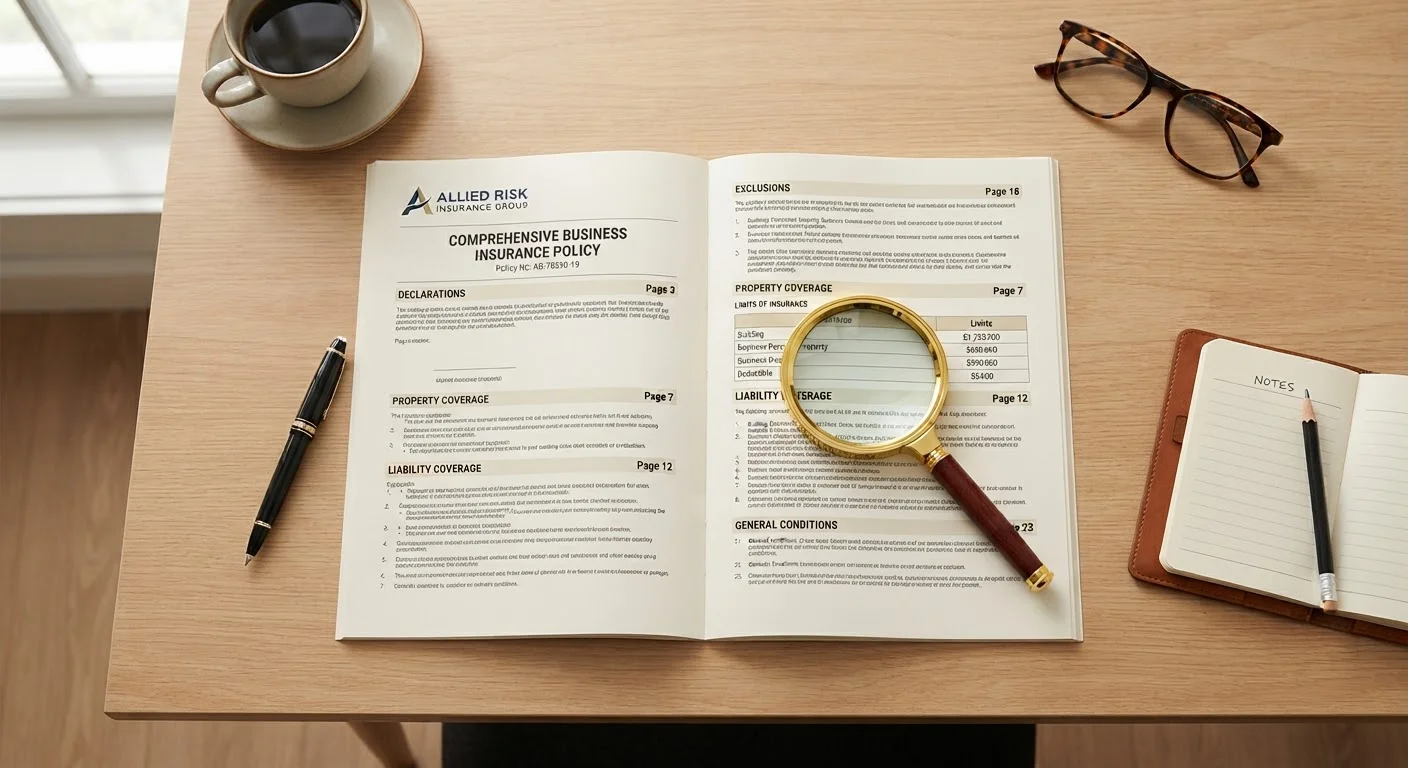
Most policies include a table of contents or a section index. Before reading anything in depth, scan this list to map the document's layout. You'll find the declarations page, definitions, insuring agreement, exclusions, and conditions - often in that order. Knowing where each section lives saves time and prevents you from missing critical language buried later in the document.
If you encounter a term not defined within the policy itself, a dedicated reference like the insurance glossary every policyholder should bookmark can fill in the gaps without requiring a call to your agent for every unfamiliar word.
How to Walk Through a Policy: Step by Step
The steps below follow the natural reading order of most standard insurance policies. Work through them in sequence the first time you review a new document; for policy renewals or mid-term changes, you can jump directly to sections that have been updated.
Start With the Declarations Page
The Declarations Page (often called the "dec page") is the policy's cover sheet. It summarizes the policyholder's name, the insured property or person, the policy period, coverage types selected, coverage limits, deductibles, and premium amount. Think of it as the policy's snapshot - accurate but not complete.
Confirm that your name, address, and coverage dates are correct. Errors here can complicate claims later.
Read the Definitions Section Before Anything Else
Every policy includes a Definitions section - sometimes titled "Words and Phrases With Special Meaning." This section assigns precise legal meanings to terms used throughout the document. Words appearing in bold, quotation marks, or all-caps are almost always defined here.
Before reading coverage language, skim this section so you understand what specific words actually mean in your policy's context. For example, "you" might include household members, or "property damage" might exclude certain categories of loss.
Identify the Insuring Agreement
The Insuring Agreement is the core promise the insurer makes to you. It states, in broad terms, what events or losses the policy covers - for example, "We will pay for direct physical loss to covered property caused by a covered peril."
This language sets the outer boundary of what might be covered. Coverage grants tend to be written broadly here; the exclusions section then narrows them. Read this section to understand what the policy is fundamentally designed to protect against.
Study the Exclusions Carefully
The Exclusions section lists specific losses, causes, people, or property types the policy does not cover. Common exclusions include flood damage in standard homeowners policies, intentional acts, and wear and tear. Exclusions are where most coverage gaps hide.
Read each exclusion fully. Note whether it's absolute (no coverage under any circumstance) or conditional (coverage may apply if specific criteria are met). For a deeper look at this section, see how to read the exclusions section.
Review the Conditions
The Conditions section outlines your obligations as a policyholder and the insurer's obligations in return. Common conditions include: reporting a loss promptly, cooperating with investigations, submitting a proof of loss, and allowing the insurer to inspect damaged property.
Failing to meet a condition - even inadvertently - can give an insurer grounds to deny or limit your claim. Know what is expected of you before a loss occurs, not after.
Check for Endorsements and Riders
Endorsements (also called riders) are attachments that modify the base policy - they can add coverage, remove it, or change specific terms. They are legally part of your contract and override conflicting language in the main document.
Always check whether any endorsements are listed on your declarations page, then locate the actual endorsement forms and read them. An endorsement might restore a standard exclusion (such as adding flood coverage) or add new obligations.
Don't Skip the Definitions Section
A word that seems ordinary - like 'occurrence,' 'residence,' or 'bodily injury' - may carry a narrow technical meaning in your policy. If a term appears bolded or capitalized in the document, it almost always has a specific definition spelled out elsewhere. Reading coverage language without checking those definitions can lead to serious misunderstandings about what is actually protected.
This Is General Education, Not Legal Advice
This article explains how insurance policy documents are typically structured. It is not a substitute for reading your actual policy, consulting a licensed insurance agent, or seeking legal counsel. Coverage terms, definitions, and conditions vary significantly between insurers and policy types. Always review your specific documents and ask questions before assuming you are - or are not - covered.
After You've Read the Policy
Once you've worked through the document, compile a short list of questions for your agent - anything unclear, any coverage gap you noticed, and any exclusion that surprised you. A licensed agent is obligated to explain your policy's terms; take advantage of that.
Before you formally accept or renew a policy, use the checklist in key policy terms to confirm in writing to make sure you haven't overlooked a critical detail. Coverage needs also shift with life changes - policies worth reviewing before a life change covers when to revisit your documents. For a broader look at how coverage and claims work, explore the Coverage Explained hub.
This article provides general insurance education only and is not a substitute for personalized advice from a licensed insurance agent or attorney. Policy terms, coverage details, exclusions, and regulations vary by provider, policy type, and state. Always read your actual policy documents carefully and consult a qualified professional with questions specific to your situation.