Why Policy Structure Matters
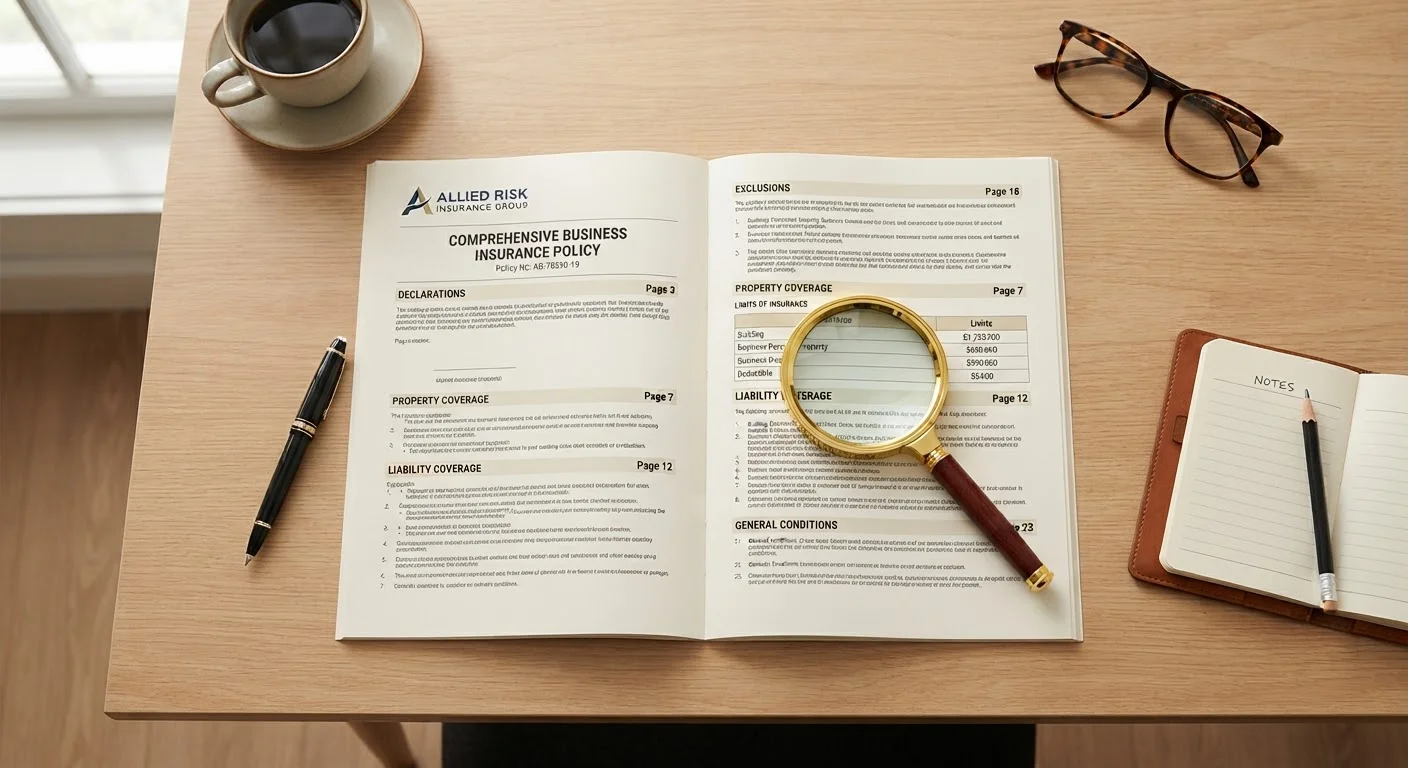
An insurance policy is a legal contract, and like all contracts, it is organized intentionally. Every section has a job to do - together they spell out what is covered, what is excluded, and what both you and the insurer must do for the agreement to hold. Most Americans receive their policies and file them away unread. That creates a gap that tends to surface at the worst possible moment: during a claim.
Knowing the architecture of a policy means you know exactly where to look when a question arises. Whether you hold auto, homeowners, health, or life coverage, the underlying structure is remarkably consistent. For a broader orientation on policy types, see the overview of major insurance categories.
1 in 8
Homeowners with a coverage gap from unread exclusions
Industry research consistently finds that many policyholders discover coverage gaps only at claim time, underscoring the importance of reading policy documents before a loss occurs.
4 to 6
Core sections found in most standard policies
Regardless of insurance type, most U.S. policy forms are organized around the same fundamental sections: declarations, insuring agreement, definitions, exclusions, and conditions.
The Declarations Page
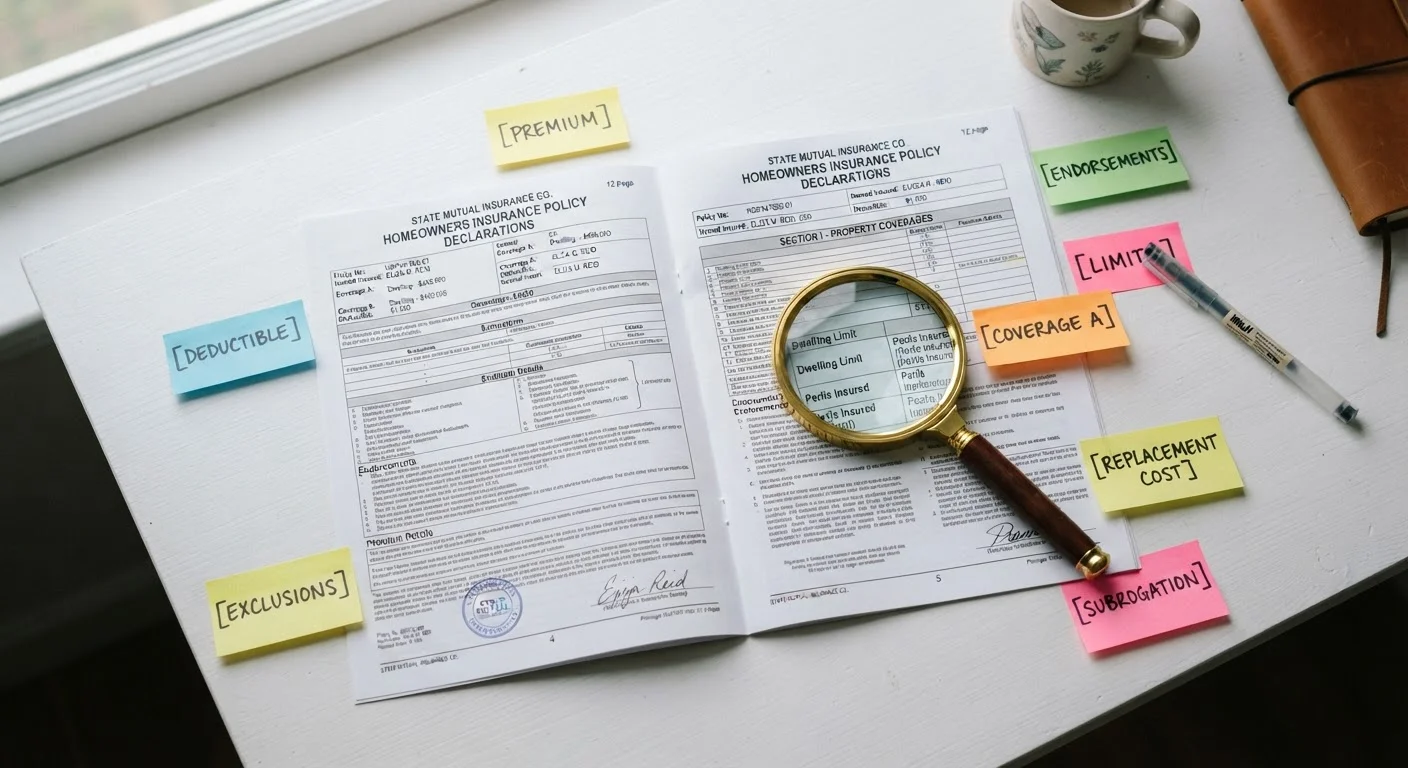
The declarations page - often called the "dec page" - is the first document in any policy packet, and it is the most personalized. It summarizes who is insured, what property or risk is covered, the coverage limits selected, the policy period (start and end dates), and the premium owed. Think of it as the policy's cover sheet.
Key items to verify on your dec page include:
- Named insured: The person or entity the policy protects. If your name is misspelled or a co-owner is omitted, correct it immediately.
- Coverage limits: The maximum dollar amount the insurer will pay per incident or per policy period.
- Deductible: The amount you pay out of pocket before coverage activates.
- Policy number: Required when reporting a claim or contacting your insurer.
The dec page does not explain how coverage works - that detail lives deeper in the policy forms that follow.
Compare your dec page against your application when the policy first arrives. If any coverage limit or deductible differs from what you requested, contact your insurer right away - corrections are far easier before a claim.
Errors on the dec page can result in unexpected out-of-pocket costs. Catching discrepancies early protects you from surprises when coverage is actually needed.
When reviewing an open-perils policy, go straight to the exclusions section first - that list defines your actual coverage more precisely than the broad insuring agreement.
Open-perils policies appear comprehensive on their face, but the exclusions section is where the real limits are set. Experienced adjusters read exclusions before anything else.
The Insuring Agreement
The insuring agreement is the heart of the contract. It states, in broad terms, what the insurer agrees to do: pay for covered losses, defend you in a lawsuit, replace a stolen item, and so on. Most insuring agreements take one of two forms:
- Named-perils coverage: Only the risks specifically listed in the agreement are covered. If a peril is not named, it is not covered.
- Open-perils (or all-risk) coverage: All risks are covered except those explicitly excluded later in the policy. This is generally broader protection.
Reading the insuring agreement tells you which framework applies to your policy - a critical distinction when assessing whether a specific loss will be paid.
Read Your Insuring Agreement First
Before reading anything else in a new policy, locate the insuring agreement and determine whether it is named-perils or open-perils. This single distinction shapes how you should interpret every other section. Named-perils policies require you to confirm a covered peril exists; open-perils policies require you to confirm an exclusion does not apply.
Definitions Section
Insurance policies use everyday words in very precise, sometimes narrow ways. The definitions section is where those terms are assigned their official meanings for the purpose of that contract. Words appearing in bold or quotation marks throughout the policy are typically defined here.
Common defined terms include occurrence, bodily injury, property damage, insured, and residence premises. The definition of "insured," for example, can determine whether a family member living in your home is covered under your policy or not.
Never assume a term means what it means in ordinary conversation. Always cross-reference the definitions section when you encounter a bolded or quoted word. For a plain-English reference to common policy vocabulary, the Insurance Glossary Every Policyholder Should Bookmark is a useful companion resource.
Exclusions: What the Policy Won't Cover
Exclusions define the boundaries of coverage by listing what the insurer will not pay for. This section is arguably the most important to read carefully, because most coverage disputes center on whether a particular loss falls inside or outside an exclusion.
Common categories of exclusions include:
- Intentional acts: Losses caused deliberately by the insured.
- Wear and tear: Gradual deterioration is generally not an insurable event.
- Specific perils: Flood and earthquake, for instance, are commonly excluded from standard homeowners policies and require separate coverage.
- Business activity: Many personal policies exclude losses arising from business use of a covered property or vehicle.
Exclusions Can Override Broad Coverage Language
A policy may use expansive language in the insuring agreement that sounds comprehensive, while the exclusions section quietly carves out significant risks. Courts have generally held that clear exclusion language controls. Never assume a loss is covered based solely on the insuring agreement - always check the exclusions section before drawing conclusions.
Understanding exclusions also helps you identify coverage gaps you may want to address with additional policies or endorsements.
Conditions and Endorsements
Conditions are the obligations both parties must fulfill for the contract to remain in force and for a claim to be paid. Policyholder conditions commonly include: notifying the insurer promptly after a loss, cooperating with investigations, protecting damaged property from further harm, and submitting a proof of loss when required. Failing to meet a condition can give an insurer grounds to deny a claim.
Endorsements (sometimes called riders or floaters) are attachments that modify the standard policy form. They can add coverage the base policy excludes, increase a coverage limit, or remove coverage for something you do not need. Endorsements carry the same legal weight as the main policy document and must be read alongside it.
For deeper context on all of these terms and more, the Insurance Terms hub provides definitions organized by concept.
This article is for general informational and educational purposes only and does not constitute personalized insurance, legal, or financial advice. Coverage terms, exclusions, and conditions vary significantly by insurer, policy form, and state. Always read your actual policy documents and consult a licensed insurance professional for guidance specific to your situation.