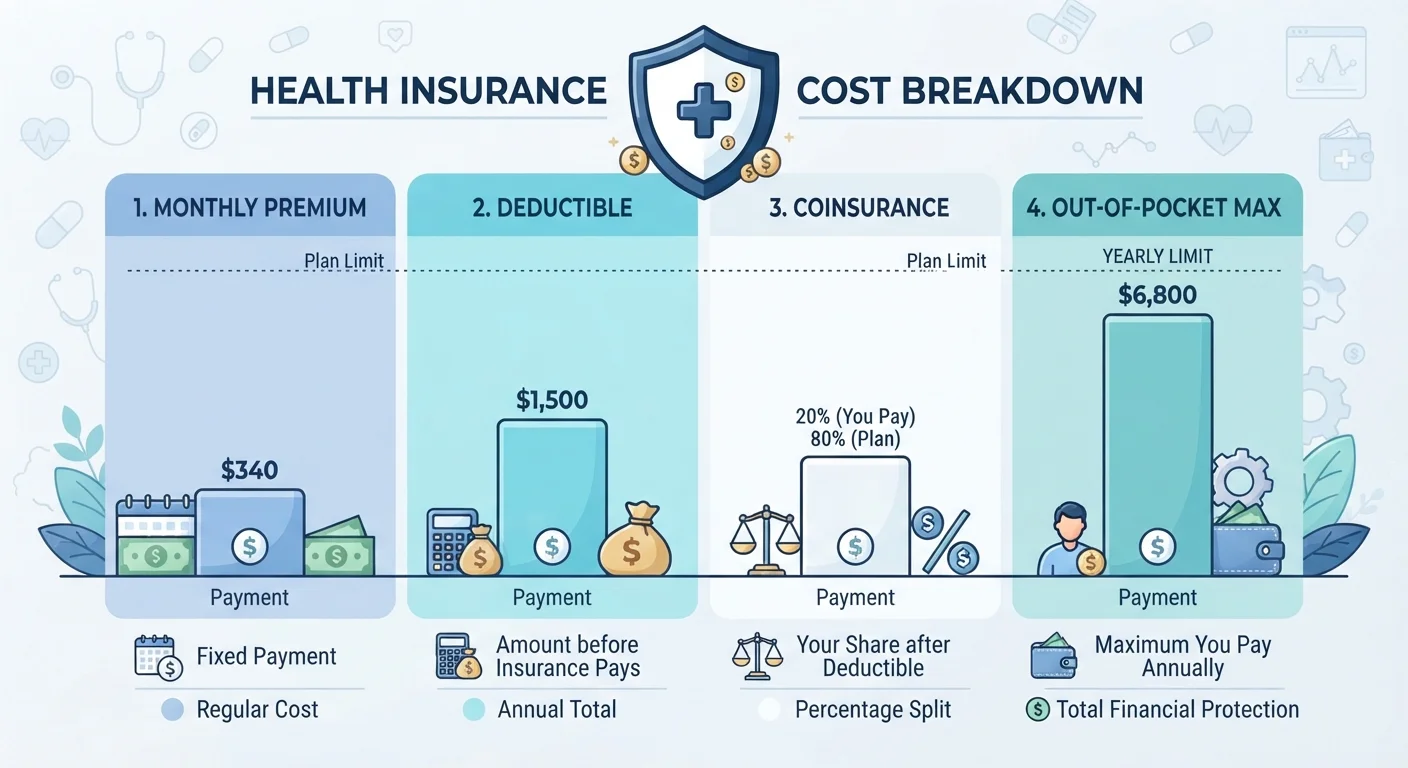

The Premium: Your Cost of Access
Think of your premium as a subscription fee for insurance coverage. You pay it monthly, quarterly, or annually - and it keeps your policy active whether or not you ever file a claim or visit a doctor.
If you have employer-sponsored health insurance, your employer typically covers part of the premium and deducts your share from your paycheck. If you purchase coverage on your own, the full premium is your responsibility.
A common misconception is that paying a premium means your insurer covers everything from the first dollar of a claim. In most cases, it does not - the premium simply buys your right to coverage under the policy terms. The deductible and copay determine how much you still pay when you actually use that coverage.
Compare Total Cost, Not Just the Premium
When evaluating plans, add up your estimated annual premium plus likely out-of-pocket costs (deductible, copays). A plan with a lower premium but a much higher deductible may cost more overall if you need regular care. Use your previous year's healthcare usage as a starting estimate.
For a broader look at how these costs fit within different types of policies, see the Coverage Explained hub for plain-language breakdowns.
The Deductible: Your Threshold Before Coverage Kicks In
Your deductible is the dollar amount you pay out of pocket for covered services before your insurer begins sharing the cost. For example, if your deductible is $1,500 and you need a covered procedure that costs $2,000, you pay the first $1,500 and your insurer covers the remaining $500 (subject to other cost-sharing rules).
Once you meet your deductible for the year, your insurer typically begins paying its share - though you may still owe coinsurance (a percentage of costs) or copays on top of that.
Not every service is subject to the deductible. Many health plans cover preventive care - like annual checkups - before the deductible is met. Review your plan's Summary of Benefits to see which services are exempt.
$1,644
Average individual health deductible in employer plans
According to the Kaiser Family Foundation's Employer Health Benefits Survey, the average annual deductible for single coverage in employer-sponsored plans has exceeded $1,600 in recent years.
$659/mo
Average unsubsidized ACA benchmark premium
The Kaiser Family Foundation reported that the average benchmark (second-lowest-cost silver) plan premium for a 40-year-old reached this level in 2024, illustrating how premium costs vary significantly by plan and region.
$30
Typical primary care copay range
Most employer-sponsored health plans set primary care copays between $20 and $40, according to Kaiser Family Foundation employer survey data, though amounts vary widely by plan type.
For a deeper dive into how deductibles interact with another key limit, see Understanding Out-of-Pocket Maximums.
The Copay: A Flat Fee at the Point of Service
A copay (short for copayment) is a fixed dollar amount you pay for a specific service at the time you receive it - commonly $20 for a primary care visit or $50 for a specialist. Unlike the deductible, a copay is the same amount every time, regardless of the actual cost of the service.
Copays are most common in health insurance, but the concept appears in other contexts too. If you're curious how similar cost-sharing terminology applies to pet health policies, the Pet Care Costs Glossary covers analogous terms for animal insurance plans.
Whether a copay counts toward your deductible or out-of-pocket maximum depends entirely on your specific plan - this is one of the most common sources of confusion among policyholders. Always verify in your plan documents rather than assuming.
How These Three Costs Work Together
These three terms don't operate in isolation - they interact to determine your real annual cost of coverage. Here's a simplified way to think about it:
- Premium: What you pay every month to have coverage at all.
- Deductible: What you pay first when you use coverage, until you hit the threshold.
- Copay: What you pay for specific services, often regardless of where you are relative to your deductible.
Choosing a plan with a lower premium often means accepting a higher deductible - which means more exposure if something unexpected happens. Conversely, a higher premium typically comes with a lower deductible and potentially lower copays, reducing your out-of-pocket risk when you use the plan frequently.
For a side-by-side look at how premiums, deductibles, and out-of-pocket maximums define the overall shape of a policy, see Deductibles, Premiums, and Out-of-Pocket Maximums.
Terminology Can Vary by Policy Type
While premiums, deductibles, and copays are standard in health insurance, the terms appear differently in other policy types. Auto and home insurance policies commonly use deductibles but not copays. Life insurance uses premiums but rarely involves deductibles in the traditional sense. Always review the specific definitions in your policy documents, as insurers can define these terms with nuances that affect how claims are processed.
This article is for general informational and educational purposes only and does not constitute personalized insurance, financial, or legal advice. Coverage terms, costs, and rules vary significantly by insurer, plan type, and state. Always read your actual policy documents and consult a licensed insurance agent or adviser for guidance specific to your situation.